

Table of Contents
- Why Envelope Design Decides Whether Your Invitation Gets Opened
- 1. Start With the Right Envelope Size for Your Invitation Suite
- 2. Choosing Envelope Paper Weight That Feels Intentional
- 3. Envelope Liner Design Inspiration for a Memorable Reveal
- 4. Custom Invitation Envelope Printing: What to Specify Before You Order
- 5. Tactile Finishes and Sealing Methods That Hold Up in the Mail
- 6. Color, Typography and Visual Hierarchy Across the Whole Suite
- 7. Eco-Friendly Materials, Accessibility and Budget Hacks That Still Look High-End
- Frequently Asked Questions
Last Updated: October 1, 2026
Why Envelope Design Decides Whether Your Invitation Gets Opened
Envelope design is the practice of choosing the size, paper, liner, printing, and sealing method for an envelope so the mailer looks intentional before it is opened. For event planners, it is the first physical contact a guest has with an event. Get it wrong and the invitation reads as bulk mail.
This guide from Atlantic Envelope covers ten creative envelope design tips for event planners, from size and paper weight through to sealing methods that survive the postal system. We have supplied printed envelopes since 1982, and the questions planners ask us have barely changed: what size do I need, what paper feels right, and will it arrive intact? Below, we walk through each decision in the order you will actually make it.
A common mistake is treating the envelope as packaging rather than part of the invitation suite. Guests handle the envelope first, so texture, weight, and typography set expectations before a single word of the invitation is read.
1. Start With the Right Envelope Size for Your Invitation Suite
Size is the decision that constrains every other one. Choose it before you commission printing, because an invitation card that does not fit its envelope forces a redesign of the whole suite.
For event work, three announcement sizes cover most projects. The A-7 Announcement Envelope (5-1/4" x 7-1/4") is the standard for formal invitations, wedding announcements, and graduation notices, and it takes a 5" x 7" card with room for inserts. The A-6 Announcement Envelope (4-3/4" x 6-1/2") suits RSVP cards, shower invitations, and thank-you notes. The compact A-2 Announcement Envelope (4-3/8" x 5-3/4") handles enclosure cards and informal notes.

If your mailing includes a program, menu, or schedule that must travel flat, step up to a booklet format.
Matching Envelope Size to Card Size
Measure the card, add the thickness of every insert, and then check the envelope's stated compatibility. A 5" x 7" card in an A-7 envelope leaves roughly a quarter inch of clearance on each side, which is enough for a lined envelope but not for a rigid insert. Order a sample pack and assemble one complete suite by hand before you commit to a bulk run.
2. Choosing Envelope Paper Weight That Feels Intentional
Paper weight is measured in pounds per ream or in grams per square metre, and it is the single strongest signal of quality a guest can feel through their fingertips. A flimsy envelope undermines an expensive invitation.
What Paper Weight Signals to Guests
Weight communicates formality. A substantial envelope suggests a formal event; a light one suggests something casual or promotional. If your event is black tie, the envelope should feel like it belongs at the same table.
3. Envelope Liner Design Inspiration for a Memorable Reveal
Envelope liner design inspiration usually comes from the event itself. A liner is a paper insert glued inside the flap, and it is the detail guests see in the half second between opening the flap and pulling out the card.
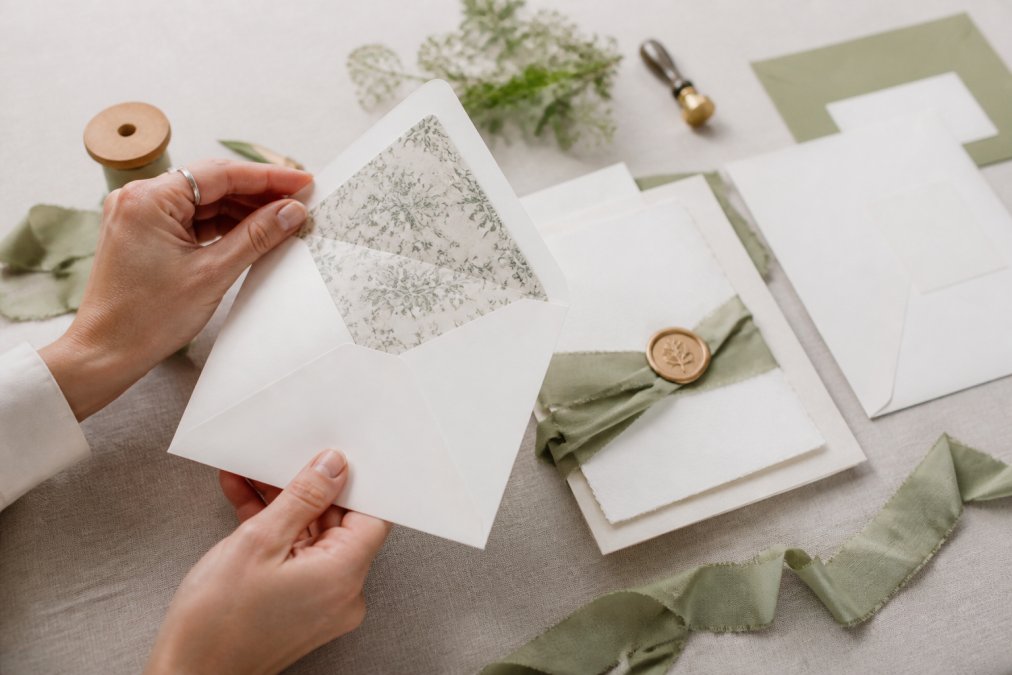
Patterns, Colors and Printed Interiors
Solid liners in a single accent color are the safest choice and the easiest to coordinate across a large guest list. Printed interiors, whether a repeating monogram, a map of the venue, or a custom illustration, carry more personality but need a bigger print run to justify the setup cost. If you are working with a tight budget, a solid liner in the event's secondary color delivers most of the visual impact for far less.
4. Custom Invitation Envelope Printing: What to Specify Before You Order
Custom invitation envelope printing fails for one reason more often than any other: the planner specifies the design but not the placement. Before you approve a proof, confirm four things in writing.
- Return address position: top-left of the front, or on the back flap. Back-flap printing keeps the front clean but hides your details from a quick scan.
- Ink color and coverage: white ink on a dark envelope behaves differently from dark ink on white stock, and heavy coverage can crack along the flap crease.
- Font size and weight: address blocks need to stay legible at arm's length. Thin script fonts disappear on textured stock.
- Bleed and margins: printed borders must sit far enough from the edge to survive trimming.
Addressing, Return Address and Branding Placement
Hand-addressed envelopes remain the formal standard for weddings and milestone events, and calligraphy is still the clearest signal of a formal occasion. For larger corporate mailings, printed addressing is faster and more consistent, and it lets you include a return address and a small logo mark without crowding the front. Reserve the back flap for branding if you want the front to stay minimal.
5. Tactile Finishes and Sealing Methods That Hold Up in the Mail
Sealing is where beautiful envelopes fail. A wax seal that pops off in transit, or a gummed flap that lifts in humid weather, turns a carefully designed suite into a damaged one.
Adhesives, Wax Seals and Hand-Addressed Alternatives
Hand-addressed envelopes cannot run through automated sorting equipment in the same way as printed ones, and unusual shapes or heavy embellishments may require hand cancellation. Build that into your timeline. If a mailing must hit a date, test one sealed envelope by mailing it to yourself a week before the main run.
6. Color, Typography and Visual Hierarchy Across the Whole Suite
Visual hierarchy is the order in which a guest's eye travels across a design, and on an envelope it is set by three elements: the stamp or indicia, the address block, and your return address. The address block should win. Everything else is supporting cast.
7. Eco-Friendly Materials, Accessibility and Budget Hacks That Still Look High-End
Sustainable envelope choices have moved from niche to expected, particularly for corporate events where guests notice waste. Recycled and responsibly sourced paper stocks are widely available, and a solid liner uses less material than a printed one while looking just as considered. Avoiding over-sized envelopes that need extra filler is another quiet win.
| Decision | Budget Approach | High-End Approach | Best For |
|---|---|---|---|
| Envelope size | A-2 or A-6 | A-7 with inserts | Small notes vs. formal invitations |
| Paper weight | Standard text weight | Heavy card-matched stock | Volume mailings vs. milestone events |
| Liner | Solid accent color | Printed custom pattern | Tight budgets vs. statement reveals |
| Sealing | Gummed flap only | Gummed flap plus wax seal | Reliability vs. presentation |
| Addressing | Printed addressing | Hand calligraphy | Corporate mailings vs. weddings |
Frequently Asked Questions
What are some creative ideas for envelope design?
Start with a patterned envelope liner, which gives the flap interior a printed reveal when the guest opens it. Add a tactile element such as textured cardstock, embossing or foil stamping on the return address, and finish with a wax seal or a printed envelope seal. Keep typography and color palette consistent with the invitation suite so the envelope reads as part of one design rather than an afterthought. Even small details like a colored gummed flap or a monogram on the back can set the tone before the card is seen.
How do I choose the right envelope size for a formal event?
Match the envelope to the card, not the other way around. A 5" x 7" invitation fits an A-7 Announcement Envelope at 5-1/4" x 7-1/4", the most common size for weddings, graduations and formal announcements. Mid-size cards and RSVP pieces work well in an A-6 Announcement Envelope at 4-3/4" x 6-1/2", while smaller thank-you notes suit the A-2 at 4-3/8" x 5-3/4". If you are mailing a program, menu or multi-page insert flat, use a 6 x 9 or 9 x 12 Booklet Envelope instead.
What are the best paper stocks for luxury event invitations?
Heavier stocks read as more premium because they hold their shape and resist bending in transit. For an invitation suite, look for a cardstock that feels substantial in the hand and pairs with an envelope of similar weight so the whole piece feels consistent. Textured paper adds a tactile quality that smooth stock cannot match, and it takes embossing and foil stamping well. Request a sample before committing to a bulk order so you can feel the weight and see how the color palette reads on the actual stock.
Should event envelopes be printed or hand-addressed?
Both work, and the choice depends on guest count and the tone you want. Hand-addressed envelopes, whether in calligraphy or clean handwriting, signal formality and personal attention, which suits weddings and smaller gatherings. Printed addressing is faster and more consistent for large guest lists, and it lets you carry typography and branding from the invitation onto the envelope.
How can event planners use custom envelopes to increase RSVP rates?
Make the reply as easy as possible. Include a pre-addressed, pre-stamped RSVP envelope in the suite so guests only need to fill in the card and drop it in the mail. Pair that with a clear RSVP deadline printed on the card and a digital RSVP option such as a QR code for guests who prefer responding online. An envelope that looks considered, with a liner, a seal and consistent branding, also raises the perceived importance of the event, which encourages guests to respond rather than set the invitation aside.