

Table of Contents
- Branded Business Stationery vs Generic Envelopes: A Direct Comparison
- What to Include on a Business Envelope for Maximum Impact
- Types of Business Envelopes and How to Match Them to Your Mailings
- Business Stationery Examples: What a Complete Branded Package Looks Like
- Business Envelope Design Ideas That Reinforce Brand Recognition
- Cost, ROI, and Operational Considerations for Branded vs Generic Envelopes
- Conclusion: Choosing the Right Envelope Strategy for Your Business
- Frequently Asked Questions
Last Updated: October 7, 2026
Branded Business Stationery vs Generic Envelopes: A Direct Comparison
Branded business stationery is printed mailing material carrying a company's logo, colors, and typography on envelopes, letterheads, and notepads; generic envelopes are unprinted stock bought purely for function.
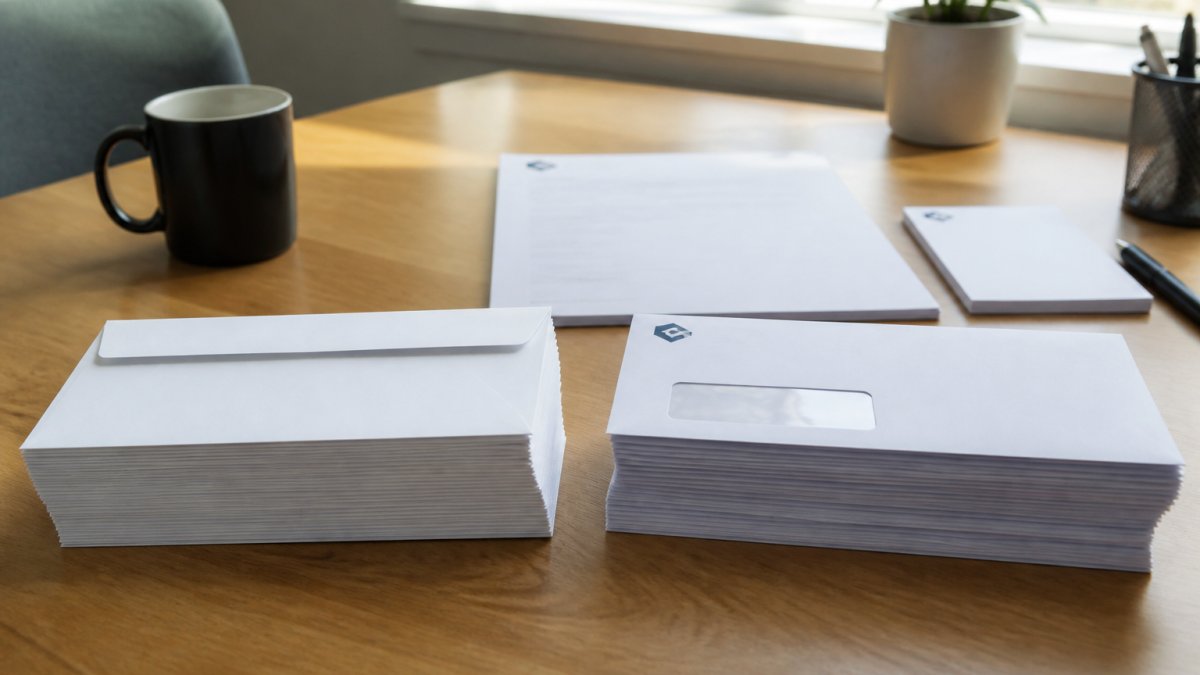
What Sets Branded Stationery Apart from Generic Envelopes
Branded stationery turns every outgoing envelope into a customer touchpoint. A custom-printed envelope carries your logo, brand colors, and corporate typography before anyone reads a word inside, building recognition across repeated mailings.
Generic envelopes arrive blank, indistinguishable from junk mail, with no visual cue that a real business sent them. For offices sending regular client communication, that compounding effect matters more than any single mailing.
When Generic Envelopes Are the Smarter Choice
Generic envelopes win in specific situations. For internal documents, drafts, or test batches, printed stock adds cost with no audience to impress. High-volume operations with tight per-piece budgets may also choose plain envelopes for low-stakes mailings where response rate is not the goal. Generic envelopes are not a failure, they are a tool for mail that never reaches a customer's decision-making process.
What to Include on a Business Envelope for Maximum Impact
What to include on a business envelope comes down to five elements: a return address, your logo, brand colors, consistent typography, and a clear recipient block. The return address establishes legitimacy and handles undeliverable mail. Your logo, placed in the upper-left corner, is the first thing a recipient's eye lands on. Brand colors and the same typeface used on invoices and marketing materials tie the package together as one system.
- Return address with full business name
- Logo in the upper-left corner
- Brand colors matching your letterhead
Types of Business Envelopes and How to Match Them to Your Mailings
Types of business envelopes fall into a few standard formats, and matching the format to the mailing matters as much as the printing. The wrong size forces folding compromises that make even branded mail look rushed.

Standard Business Envelopes for Everyday Correspondence
The #10 Regular Envelope is the workhorse of business correspondence. At 4-1/8" x 9-1/2", it fits a standard 8-1/2" x 11" letter folded in thirds, covering invoices, letters, statements, and checks.
For reply mail, the #9 Regular Envelope at 3-7/8" x 8-7/8" fits neatly inside a #10, making it the natural choice for remittance and return envelopes. Smaller correspondence, greeting cards, and promotional inserts work well in the #6-3/4 Regular Envelope at 3-5/8" x 6-1/2".
USPS guidance on business mail preparation
Window Envelopes for Billing and High-Volume Mail
The #10 Window Envelope displays the recipient's address printed directly on your document through a clear poly window, so you skip separate address labels entirely, removing a step from every billing statement, payroll, or financial mailing.
High-volume automated mailing is where window envelopes pay off. The left-positioned window aligns with standard document formatting, so your existing invoice template usually works without redesign, and gummed flap closure keeps the seal reliable through postal handling.
Business Stationery Examples: What a Complete Branded Package Looks Like
Business stationery examples that work share one trait: every piece looks like it came from the same company. A complete branded package includes:
- Letterhead with logo, address, and brand colors
- Custom printed envelopes matching the letterhead design
- Notepads for internal and client-facing notes
The reply envelope is the piece most businesses forget. When a customer mails back a payment or response card, that envelope is a second brand impression. A branded #9 reply envelope inside a branded #10 outer envelope closes the loop.
Business Envelope Design Ideas That Reinforce Brand Recognition
Business envelope design ideas should serve recognition first and decoration second. The strongest designs are restrained: logo in the corner, brand color as a thin rule or accent, and clean typography for the address block. The goal is an envelope a recipient recognizes in a stack before reading the return address, built through repetition of three consistent cues:
- A fixed logo position. Upper-left corner is the convention because it is where the eye lands first on a standard #10. Moving the logo between mailings breaks the pattern the recipient is learning.
- One signature brand color. A single accent, a rule, a bar, or a colored logo, is easier to recognize at a glance than a full-color design.
- Consistent typography. The same typeface on the envelope, letterhead, and invoice makes the whole package read as one system. Switching typefaces is the most common way offices accidentally look like several different companies.
What to Avoid
Design choices that hurt recognition are usually the ones that prioritize decoration over consistency:
- Heavy ink coverage in the lower-left corner. Postal sorting equipment reads that zone, and dense coverage can slow processing or smudge on high-volume runs.
- Changing the design between mailings. A recipient who sees three different envelope designs from the same company learns nothing.
- Crowding the address block. Decorative elements near the recipient address can interfere with automated address reading and slow delivery.
Brand recognition compounds through repetition. A recipient who sees the same logo, color, and typeface on three mailings starts recognizing your envelope in the stack before reading the return address. The design's job is to make that repetition easy, not to be interesting on its own.
Cost, ROI, and Operational Considerations for Branded vs Generic Envelopes
Cost per piece is the wrong metric on its own. The right question is cost per exposure: how much you pay for each recipient who registers your brand. A branded envelope delivers a brand impression a generic envelope cannot. The cost drivers that separate the two fall into four buckets:
- Unit cost. Generic envelopes are commodity stock, priced by pack size and bought off the shelf. Branded envelopes add printing, so the per-piece cost depends on ink coverage, number of colors, and whether you print one side or two.
- Setup cost. Custom printing requires an artwork file, a proof, and a plate or digital setup before the first envelope runs, a fixed cost amortized across the order, so larger runs weigh less on each piece.
- Order quantity. Generic stock can be bought in small packs the day you run out. Branded stock is typically ordered in a print run sized to your mailing volume.
That last point is the one most teams underestimate. A rebrand or office move can strand a full print run of envelopes that no longer match your letterhead. Size print runs to a realistic usage window, many offices find a few months of stock is a safer commitment than a year.
Factor |
Branded Envelopes |
Generic Envelopes |
|---|---|---|
Unit cost |
Higher; driven by ink coverage and colors |
Lower; commodity stock |
Setup cost |
Artwork, proof, and print setup required |
None |
Order quantity |
Print run sized to mailing volume |
Small packs, bought on demand |
Brand impression |
Every mailing |
None |
Best for |
Client communication, campaigns, statements |
Internal mail, test batches, low-stakes mail |
Lead time |
Print and proofing time before delivery |
Available immediately |
Inventory risk |
Obsolete after rebrand or address change |
None |
Operational needs |
Artwork file, address alignment, print lead time |
None |
Operational considerations matter as much as cost. Custom printed envelopes require an artwork file and a print run, so plan ahead; generic envelopes can be bought the day you run out.
Operational and Compliance Details That Affect the Choice
Beyond cost, a few practical requirements shape which envelope you can use at all:
- Address-window alignment. Window envelopes only work if your document's address block lines up with the window position. Standard left-positioned windows match most invoice templates, but a custom layout may need adjustment.
- Postal preparation. Automation-friendly mail, barcoded, presorted, and machine-readable, depends on clean address zones and consistent envelope stock. Heavy ink coverage in the lower-left corner can slow processing or cause smudging.
- Privacy. Window envelopes expose whatever is printed at the address position. If your document shows account numbers or balances near the address block, a window envelope can leak information a closed-face envelope would not.
Environmental Impact and Responsible Sourcing
Paper sourcing belongs in this calculation too. When comparing suppliers, ask about recycled content, responsible forestry certification, and whether the inks are vegetable- or water-based rather than petroleum-based. The environmental case for branded envelopes depends on whether the printed mail gets kept: a branded statement a customer files away has a longer useful life than a generic envelope that goes straight to recycling, but a branded envelope discarded unopened carries the same footprint as a plain one plus the printing.

Measuring Effectiveness: Testing and Tracking Your Mailings
Testing settles the branded-versus-generic question for your own business. Split a mailing: send half your list branded envelopes and half generic, keeping contents identical so the envelope is the only variable. Then track:
- Response rate, replies, returns, or RSVPs per group.
- Payment timing, for invoices, how quickly each group pays.
- Open and retention signals, whether recipients reference the mailing, call in, or return a reply envelope.
Run the test across at least two cycles before drawing conclusions, single mailings are noisy, and seasonal timing can distort results. Keep sample sizes comparable and resist changing the envelope design mid-test.
A common pattern is that branded envelopes move the needle most on first-contact mail, statements, welcome letters, and campaign pieces sent to recipients who do not yet know the business, and least on recurring mail to established customers who already recognize the return address.
Canada Post business mail resources
Conclusion: Choosing the Right Envelope Strategy for Your Business
The decision is not branded or generic forever. It is which mailings deserve a brand impression and which ones only need to arrive. Client invoices, statements, event invitations, and campaign mail earn printed envelopes; internal routing and test batches do not.
Atlantic Envelope has supplied printed envelopes to offices, event planners, and home-based professionals since 1982, with a range that runs from standard business and window envelopes to custom announcement sizes.
Frequently Asked Questions
What is the difference between branded and generic envelopes?
Generic envelopes are plain, unbranded stock, usually white with no printing. Branded business stationery carries your logo, return address, brand colors, or a design element printed directly on the envelope. The practical difference shows up the moment a recipient opens their mailbox: a branded envelope signals who sent it before it is opened, while a generic one looks like any other piece of mail. That distinction affects recognition, trust, and how quickly your correspondence gets attention.
When should a business use branded envelopes?
Use branded envelopes for anything tied to client communication, billing, contracts, or marketing where recognition matters. Invoices, statements, proposals, event invitations, and direct mail campaigns all benefit from a printed logo and return address. Generic envelopes make sense for internal drafts, low-priority notices, or bulk mailings where the contents carry the message and the envelope is purely functional. Matching the envelope to the mailing's purpose keeps costs sensible while protecting your professional appearance where it counts.
What should you include on a business envelope?
At minimum, include your company name and return address in a consistent position, usually the top-left corner. Add your logo for brand recognition, and consider a tagline or a small brand color accent. For window envelopes, confirm the recipient's address prints in the correct position on your document so it shows through the clear poly window. Keep the design clean: too many elements compete for attention and reduce the polished look that makes branded stationery worth the investment.
Are plain envelopes suitable for professional business mail?
Yes, for some mailings. Plain envelopes work well for internal documents, routine notices, or high-volume campaigns where the contents do the persuading. However, for client-facing correspondence such as invoices, contracts, or event invitations, a plain envelope can look indistinguishable from junk mail. The decision comes down to whether the recipient needs to recognize the sender before opening. If recognition matters, branded envelopes deliver a measurable advantage in how the mail is perceived.
Which types of business envelopes work best for high-volume billing?
#10 window envelopes handle high-volume billing reliably because the recipient's address shows through the window, eliminating separate labels and speeding up automated mailing. They pair with 8-1/2 x 11 sheets folded in thirds. For reply mail included in a billing package, a #9 regular envelope fits neatly inside a standard #10 and gives customers a convenient way to return payment. Matching envelope type to mailing volume keeps your process efficient and your mailings consistent.