

Table of Contents
- Why the Right Business Envelope Matters
- Business Envelope Sizes and Uses: A Practical Match Guide
- Types of Business Envelopes and What Each One Is For
- Window Envelopes for Business: When They Save Time and When They Don't
- Custom Printed Business Envelopes: Branding Without the Guesswork
- Paper Stock, Closures, and Security Features
- Postage, Compliance, and Total Mailing Cost
- Ordering Quantities, Lead Times, and a Simple Decision Framework
- Frequently Asked Questions
Last Updated: October 18, 2026
Why the Right Business Envelope Matters
A business envelope is the first physical thing your customer touches, and it makes a judgment before they open it.
Envelope choice is not a style question, it is a logistics question. Size decides folding, folding decides paper weight, and paper weight decides postage. Get the order backwards and you pay for it twice.
Below, we walk through business envelope sizes and uses, the main types of business envelopes, and a simple framework for picking the right one, including the cost and compliance details that decide whether a mailing actually works.
Business Envelope Sizes and Uses: A Practical Match Guide
Start with the document, not the envelope. The paper you are mailing sets the size, and the size sets everything else.
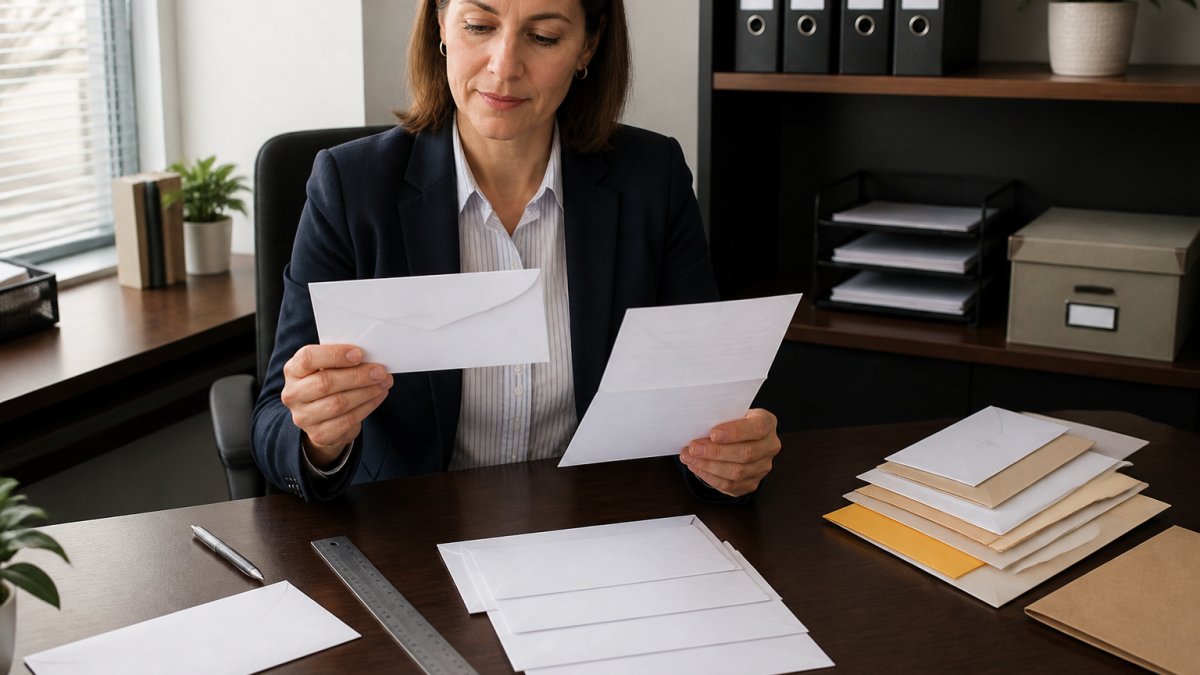
The #10 envelope is the workhorse of business correspondence. It measures 4-1/8" x 9-1/2" and holds a standard 8-1/2" x 11" sheet folded in thirds.
Smaller formats handle smaller jobs. The #9 envelope (3-7/8" x 8-7/8") is built to sit inside a #10, which makes it the natural reply or remittance envelope.
Matching Envelope Size to Document Size
Match by fold, not by guesswork:
- 8-1/2" x 11" letter, folded in thirds → #10
- 8-1/2" x 11" letter, folded in half → booklet or catalog envelope
- Half-sheet or quarter-fold card → #6-3/4
- Reply slip for a #10 mailing → #9
Folded vs. Unfolded Mailing
Folding saves money on paper and postage; unfolding looks better for certificates, contracts, and presentation pieces. Folded mail fits standard commercial envelopes and machines well, while flat mail needs a larger format and often costs more to send.
Types of Business Envelopes and What Each One Is For
The market splits into commercial, booklet, and specialty formats.
Commercial envelopes are the everyday business format, with the #10 as the standard. They open along the long edge and suit automated inserting.
Booklet and catalog envelopes open along the short edge and take unfolded sheets. Catalog envelopes are the larger of the two.
Specialty formats cover the rest: window, clasp, self-seal, security-tinted, and coin envelopes. Each solves one problem well.
Commercial vs. Booklet and Catalog Formats
| Format | Typical Use | Folding | Best For |
|---|---|---|---|
| Commercial (#10) | Letters, invoices, statements | Thirds | High-volume business mail |
| Booklet | Brochures, proposals | None or half | Presentation pieces |
| Catalog | Catalogs, contracts, flat mail | None | Unfolded documents |
| Window | Statements, billing | Thirds | Automated mailings |
| #9 Reply | Remittance, responses | Thirds | Return envelopes |
Window Envelopes for Business: When They Save Time and When They Don't
Window envelopes for business earn their place in one scenario: high-volume mail where the address is already printed on the document. The window shows the recipient's address through the paper, skipping separate labels and a whole production step.
Our #10 Window Envelope does exactly this, with a clear poly window positioned left and a gummed flap. For billing teams sending statements to thousands of customers, it removes a failure point: no label to peel, no address to misalign.

Custom Printed Business Envelopes: Branding Without the Guesswork
Custom printed business envelopes turn routine mail into recognition. A logo on the front, a return address in the right spot, and consistent paper stock do more for brand recall than most people expect.
Keep the design disciplined:
- Logo placement: top-left, sized to stay clear of postage and addressing
- Address panel: leave clean space for machine printing
- Return address: consistent position on every mailing
- Color: full-color printing works, but keep contrast high for scanning
Custom printing carries setup. A home-based professional sending a few dozen invoices a month may find a stock envelope and a printed return address suitable; a marketing team running a direct mail campaign may find custom printing beneficial.
Paper Stock, Closures, and Security Features
Paper stock decides how an envelope feels in the hand. A thin sheet reads as cheap; a heavier stock reads as intentional.
Closures include gummed flaps. Our #10 Regular Envelope, #10 Window Envelope, #9 Regular Envelope, and #6-3/4 Regular Envelope all feature a gummed flap closure.
Security matters for anything with account numbers or payment details. A security-tinted envelope hides the contents from light and prying eyes. For billing and payroll, that is not optional.
Postage, Compliance, and Total Mailing Cost
Postage is where envelope choices can add up. Size, weight, and thickness all feed into what you pay per piece, and a format that needs extra handling may cost more than the envelope itself. The envelope is a variable in the rate calculation, and considering it can help with a predictable mailing budget.
How Envelope Choices Drive Postage
Four envelope attributes move the rate:
- Size. Most postal operators sort mail into letter, large-letter (flat), and parcel tiers by dimension. A #10 envelope is typically classified as a letter; other envelope types may fall into different pricing tiers. Choosing a different format can change the rate class, not just the per-piece cost.
- Weight. Paper stock, inserts, and the envelope itself all count. A heavier envelope stock plus a multi-page statement can push a piece over a weight threshold. Weigh a filled sample, never an empty envelope.
- Thickness. Packed thickness affects whether a piece machines cleanly. Uneven thickness, a folded letter with a bulky insert on one side, causes jams and can trigger non-machinable surcharges.
- Machinability. Envelopes that feed through automated sorters avoid manual-handling fees. Clasp closures, rigid contents, and irregular shapes are common culprits for non-machinable classification.
A practical pattern most mailers settle into: standardize on one or two formats so a single rate class applies across the run, then test a filled sample for weight and thickness before committing to a print order.
A Pre-Order Mailing Compliance Checklist
Compliance failures can often be related to layout. Run this checklist against a printed sample:
- Address block position, confirm the recipient address sits within the clear zone your postal operator specifies for machine reading.
- Return address, place it consistently (typically top-left on the front) and keep it clear of postage and the address block.
- Window alignment, if using a window, verify the address shows fully through the window with margin on all sides after folding, not just before.
- Postage area, leave the top-right corner clear for indicia or stamps.
- Barcode clear zone, keep the bottom edge free of graphics, text, and window edges so sorting equipment can read the barcode.
- Contrast, print addresses in dark ink on a light background; low-contrast or reversed-out addresses defeat optical reading.
Protecting Sensitive Contents
If your mail carries account numbers, payment details, or personal data, the envelope is part of your privacy controls. A security-tinted interior conceals contents from light and casual inspection.
For current postage rates, size tiers, and machinability rules, check the official postal service guidance for your market before you print. Rates and thresholds change, and a format that mailed cleanly last year may need rechecking.
Universal Postal Union standards and guidance
Ordering Quantities, Lead Times, and a Simple Decision Framework
Ordering is where good intentions meet real budgets. Two rules cover most of it: buy enough to avoid a reorder mid-campaign, and leave lead time for printing and shipping.
Balancing Quantity, Storage, and Replenishment
Custom printing carries setup work, so short runs may have a higher per-unit cost compared to longer runs. A few practical patterns:
- Match quantity to a realistic mailing cycle. Estimate monthly volume, then order enough to cover a quarter or two rather than a single campaign. This spreads setup across more pieces without tying up storage indefinitely.
- Account for storage conditions. Envelopes are paper. Damp storage warps flaps, and gummed flaps can lose their seal in humid conditions. Store flat, dry, and off the floor.
- Plan replenishment before you run low. Note the lead time on your last order and set a reorder trigger at roughly that lead time plus a buffer, so a campaign never waits on stock.
- Lock artwork and stock before the first run. The second order should reproduce the first exactly; if the artwork file or paper stock changes, the brand impression drifts.
Lead Times to Build Into Your Calendar
Lead time is not one number, it is a chain: artwork approval, printing, and shipping. Build each link into your mailing date. Place the order well before deadline pressure starts, confirm a printed proof, and schedule delivery with buffer before the mailing date. If a mailing has a fixed regulatory or contractual date, treat the envelope order as a critical-path item.
A Decision Framework by Task
Use this chooser to move from contents to a recommendation:
| If you are sending... | Choose... | Because... |
|---|---|---|
| Invoices or statements at volume | #10 window, security tint | Skips labeling, conceals contents |
| Letters and correspondence | #10 regular | Standard format, machines cleanly |
| A reply envelope inside a mailing | #9 inside the #10 | Fits without extra postage tier |
| Cards or small checks | #6-3/4 | Sized to the contents |
| Unfolded documents | Booklet or catalog | Avoids folding, preserves presentation |
| Sensitive contents | Security-tinted format | Protects privacy in transit |
Pre-Order Checklist
- Confirm the document size and fold
- Choose the format: commercial, booklet, window, or reply
- Pick paper stock and closure
- Decide on custom printing versus stock
- Test one filled sample for fit, weight, and window alignment
- Confirm quantity against your mailing cycle and storage capacity
- Build in lead time for artwork, printing, and shipping
- Set a reorder trigger at your lead time plus a buffer
At Atlantic Envelope, we stock the #10 Regular Envelope and #10 Window Envelope in multiple pack sizes, so a home office and a bulk billing operation can both order the quantity that fits. Our #9 Regular Envelope handles reply mail, and the #6-3/4 Regular Envelope covers cards and small inserts.
Frequently Asked Questions
What is the size of a typical business envelope?
The most common business envelope is the #10, measuring 4-1/8 inches by 9-1/2 inches. It fits an 8-1/2 by 11 inch sheet folded in thirds, which is why it works for invoices, letters, statements, and checks. Smaller options like the #9 (3-7/8 by 8-7/8 inches) fit inside a #10 as a reply envelope, while the #6-3/4 (3-5/8 by 6-1/2 inches) suits notes and small inserts. Start with #10 for daily correspondence, then add other sizes only when your documents demand them.
How do I choose the right envelope size for a business letter?
Measure your document first, then decide whether it will be folded. A standard letter folds in thirds into a #10 envelope, the default for business correspondence. If you are mailing contracts or brochures you do not want creased, choose an envelope that holds the sheet unfolded. Confirm the packed thickness stays within your postage tier, and check that inserts like reply envelopes still fit without bulging. Order a small test batch before committing to a bulk run.
Should I use a window envelope for business mail?
Window envelopes for business make sense when you send invoices, statements, or payroll at volume. The clear window displays the recipient address printed on the document, so you skip separate labels and speed up assembly. Choose a window position that lines up with your template, and confirm the address stays visible after folding. For handwritten notes, invitations, or mail where the address is not printed on the insert, a regular envelope gives you more flexibility and a cleaner look.
What should I check before ordering custom printed business envelopes?
Confirm four things: the envelope size and format, where your logo and return address will sit, and the paper stock weight. Ask for a proof so you can check logo placement against the flap and window before the full run. Ordering a sample first prevents costly reprints on a large batch.