

Table of Contents
- Understanding Secure Adhesive Seals and Their Role in Mailing
- Self-Adhesive Envelope Seals: What They Are and When to Use Them
- Self-Adhesive Address Labels for Mailing and Organization
- Bulk Mailing Labels: Scaling from Small Orders to High-Volume Campaigns
- Tyvek Envelopes and Durable Mailing Solutions
- Selection Criteria: Matching Adhesive Seals to Your Mailing Needs
- Common Mistakes to Avoid When Choosing Adhesive Seals
- Frequently Asked Questions
Last Updated: October 11, 2026
Understanding Secure Adhesive Seals and Their Role in Mailing
Secure adhesive seals are tamper-evident closures designed to protect the integrity of envelopes and packages during transit. Unlike standard envelope flaps, these seals provide visible evidence if someone has opened or tampered with your mail before it reaches the recipient. Whether you're sending invoices from a home office or managing thousands of pieces for a bulk mailing campaign, the right seal makes the difference between professional presentation and potential security concerns.
Secure adhesive seals create a physical and visual barrier that deters tampering and provides accountability. For businesses handling sensitive documents, financial statements, or confidential information, this assurance is essential.
Self-Adhesive Envelope Seals: What They Are and When to Use Them
Self-adhesive envelope seals are pre-glued closures that stick directly to envelope flaps without requiring additional moisture or adhesive. They come in various formats: full-flap seals, security tape strips, or spot seals positioned at specific points.
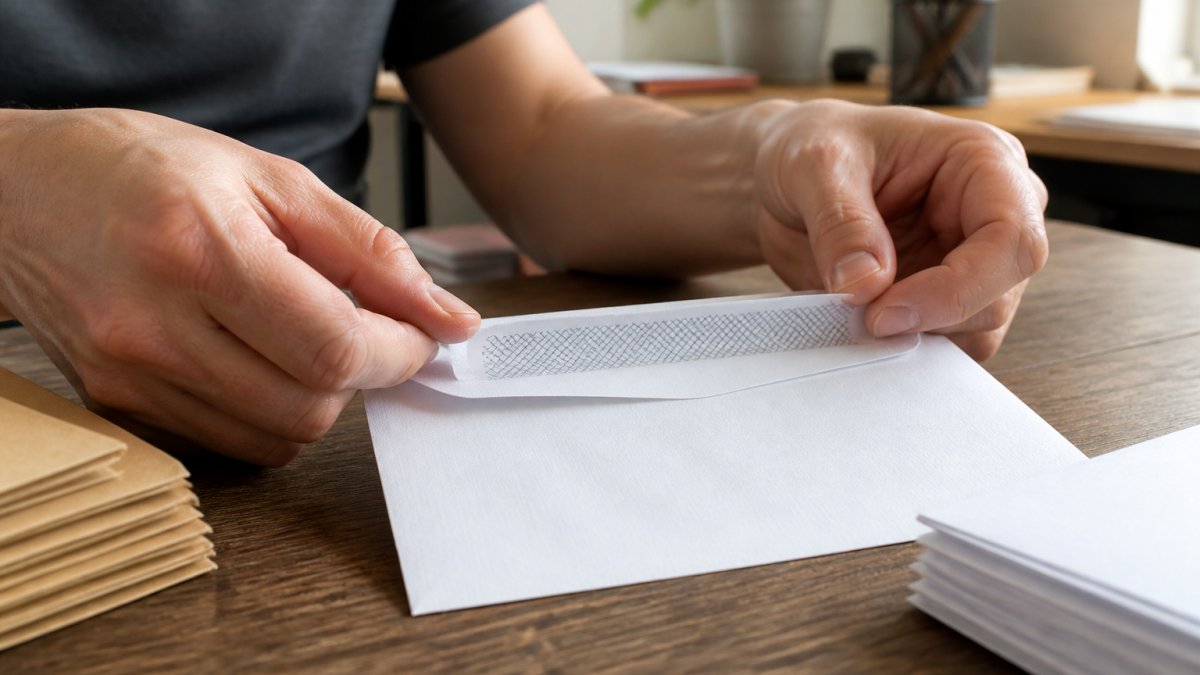
These seals work best for mailings where appearance and security matter equally. Home-based professionals benefit from the polished look and tamper evidence, while bulk campaigns need seals that perform reliably through automated mail processing equipment without jamming or peeling.
How Tamper Evidence Actually Works
Tamper evidence combines adhesive behavior and material design to create visible, irreversible proof of disturbance. When a seal is removed, one of three mechanisms typically activates:
Adhesive residue transfer: The seal's adhesive grips the envelope surface so firmly that removing it tears the paper or leaves behind adhesive residue. This is the most common and cost-effective tamper-evidence method for standard mailings.
Void patterns and color-change inks: Premium seals incorporate hidden patterns or inks that become visible when lifted, revealing "VOID" or "OPENED" text. This method is ideal for high-security documents, financial statements, or legal correspondence.
Destructible material construction: Some seals fragment or tear when removed, making reapplication impossible and disturbance immediately visible.
Tamper-evidence effectiveness depends on adhesive strength relative to envelope material. Mismatched adhesive and envelope material can render tamper evidence ineffective, the seal peels cleanly without leaving any trace of disturbance.
Seal Integrity Under Postal Processing Stress
Seal integrity refers to how well the adhesive bond holds during mail processing, where home office assumptions often fail in bulk campaigns.
Automated mail sorters use friction wheels, conveyor systems, and pressure rollers that can exceed 50 pounds of force per square inch. A seal that feels secure by hand may peel when exposed to these forces.
For home office mailings of 50-500 pieces, seals experience minimal mechanical stress and moderate-strength adhesive performs adequately.
For bulk campaigns of 5,000+ pieces, seals must survive multiple automated sorting passes and temperature swings.
Home office seals use standard hot-melt or water-based adhesives. Bulk-processing seals use high-tack, pressure-sensitive adhesives engineered to maintain bond strength under mechanical stress and environmental variation.
Adhesive Strength and Surface Compatibility
Kraft paper, coated stock, window envelopes, and Tyvek require different adhesive formulations. A seal that grips kraft paper firmly might fail on glossy surfaces, while adhesive strong enough for coated stock can damage delicate kraft paper.
Test adhesive compatibility before committing to a large order. Apply a sample seal to your envelope stock, let it cure for 24 hours, and attempt removal. For bulk campaigns, run a pilot batch of 500-1,000 pieces through your actual mail processing equipment and document peel rate, residue transfer, and any jams.
Self-Adhesive Address Labels for Mailing and Organization
Self-adhesive address labels eliminate handwriting, reduce errors, and create uniform professional appearance. For home office use, they're faster than printing addresses directly on envelopes. For bulk campaigns, they integrate with mail-merge systems and automated applicators.
Address labels come in standard sizes and custom dimensions. The adhesive must be strong enough to survive mail sorting equipment but removable without damaging the envelope if a piece is misdirected.
Many organizations use address labels alongside secure seals. The label identifies the recipient; the seal protects the contents. This combination is especially effective for financial statements, legal documents, and confidential correspondence.
Bulk Mailing Labels: Scaling from Small Orders to High-Volume Campaigns
Scaling from home office to bulk mailing introduces new constraints: adhesive formulation, label thickness, positioning, and equipment compatibility all shift with volume. Understanding these differences prevents costly failures.
Home Office Quantities and Cost Efficiency
Home office operations typically involve 50-500 pieces per mailing. At this scale, you can afford higher per-unit costs and have time to apply labels and seals by hand or test adhesives.
For home office use, standard self-adhesive labels with moderate-tack adhesive perform well. A label that peels at a 1-2% rate is acceptable because you're only dealing with 5-10 failed pieces per mailing.
Cost per unit is higher at small volumes because setup fees and minimum orders apply.
Home office operations benefit from flexibility to adjust label size or adhesive for the next mailing without significant financial loss. This trial-and-error approach is practical at small volumes but becomes prohibitively expensive at scale.
High-Volume Mailing Performance and Reliability
High-volume campaigns demand consistency and automation compatibility.
Adhesive Selection for Automation and Durability
Bulk mailing labels use high-performance pressure-sensitive adhesives, often acrylic-based, that deliver the reliability automation demands.
Label Material and Thickness
Bulk mailing labels typically use 28-32 lb stock with a thicker adhesive layer that resists curling, tears less easily, and provides a more professional appearance.
Label thickness matters for automation compatibility. Bulk mailing labels are engineered to precise thickness tolerances to ensure smooth feeding through high-speed equipment.
Testing and Pilot Batches
Before committing to a 50,000-piece order, run a pilot batch of 500-1,000 pieces through your actual equipment.
Share pilot results with your supplier.
Volume Pricing and Supplier Relationships
Bulk mailing labels offer significant per-unit cost savings at scale. Negotiate volume pricing and establish a performance guarantee.
Regular, predictable orders allow suppliers to optimize production and offer better pricing than sporadic orders.
Transitioning from Home Office to Bulk: Common Pitfalls
Many organizations assume that a label performing well at 500 pieces will perform equally at 50,000 pieces. This assumption fails because adhesive, material, and processing conditions are fundamentally different.
Another common error is choosing labels based on appearance or cost alone. A visually attractive label that fails 5% of the time creates more problems than a plain label with 99% reliability.
Many organizations overlook the integration between labels, seals, and envelope design. A label positioned too close to the seal edge may peel during processing. Work with your supplier to ensure all components function together seamlessly, and test the complete workflow before committing to a large order.
Tyvek Envelopes and Durable Mailing Solutions
Tyvek is a synthetic material that outperforms paper in durability and tamper resistance. Tyvek envelopes resist tearing, moisture, and puncture better than kraft or coated paper.
Tyvek's smooth surface requires specific adhesive formulations. Standard paper-grade adhesives often fail on Tyvek. Seals and labels designed for Tyvek use stronger adhesives that bond reliably to synthetic surfaces.
For bulk mailing, Tyvek envelopes cost more per piece than paper alternatives, but durability and security benefits justify the investment for high-value contents.
Selection Criteria: Matching Adhesive Seals to Your Mailing Needs
Choosing the right seal and label combination requires balancing mailing volume, envelope material, security requirements, budget, and equipment constraints.
Volume, Frequency, and Budget Considerations
Small, infrequent mailings favor flexibility. You can afford premium seals with excellent tamper evidence and custom label sizes.
Regular, moderate-volume mailings benefit from standardized products and bulk discounts. Establish a relationship with a reliable supplier who maintains consistent quality.
High-volume campaigns require automation-compatible products and performance guarantees. Negotiate volume pricing and request documentation of adhesive performance under your specific conditions.
Security, Privacy, and Compliance
Sensitive mailings demand tamper-evident seals that clearly show evidence of disturbance. Verify that your chosen seal meets relevant compliance requirements, as some industries have specific standards for evidence preservation.
A seal signals to handlers that the contents are protected and shouldn't be casually opened, deterring accidental disclosure and creating accountability.
| Selection Factor | Home Office | Moderate Volume | High-Volume Campaign |
|---|---|---|---|
| Seal Type | Standard or custom | Standardized | Automation-compatible |
| Adhesive Strength | Moderate | Moderate-to-strong | High-performance |
| Volume per Order | 50-500 | 500-5,000 | 5,000+ |
| Per-Unit Cost | Higher | Moderate | Lowest |
| Application Method | Manual or simple dispenser | Basic automation | Full-line automation |
| Testing Requirement | Minimal | Moderate | Extensive |
Common Mistakes to Avoid When Choosing Adhesive Seals
The most common error is underestimating adhesive requirements. Teams assume a seal strong enough for hand application will survive mail processing equipment. A seal that seems secure on your desk may peel off after the first automated sort.
Another frequent mistake is choosing seals based solely on appearance. A visually impressive seal that fails 5% of the time creates more problems than a plain seal with 99% reliability.
Neglecting material compatibility is equally problematic. Kraft paper, coated stock, window envelopes, and Tyvek all require different adhesive formulations. Applying a paper-grade seal to a coated envelope often results in failure.
Many organizations overlook the integration between seals, labels, and envelope design. A poorly positioned seal can interfere with address labels. Work with your supplier to ensure all components function together seamlessly.
Protecting your mailings starts with choosing the right seal and label combination for your specific needs. From custom-printed security envelopes to standardized seals compatible with high-speed automation, we have the expertise to ensure your mailings arrive intact and professional. Contact us for a quote tailored to your mailing requirements, and let our team help you select products that balance security, cost, and performance.
Frequently Asked Questions
What are adhesive envelope seals used for?
Adhesive envelope seals secure the flap of an envelope after insertion of contents, providing tamper evidence and professional appearance. They're used in business correspondence, billing statements, invoices, and secure mailing to ensure contents remain protected during transport. For bulk mailing campaigns, they offer consistent sealing across thousands of pieces, while home office users rely on them for client communications and confidential documents.
How do I choose the right secure adhesive seals for my mailing volume?
Evaluate your typical monthly mailing volume, frequency of campaigns, and budget. Home-based professionals might start with smaller pack quantities of self-adhesive address labels or envelope seals, while high-volume mailers benefit from bulk mailing labels purchased in larger quantities. Consider adhesive strength for your envelope type and whether you need tamper-evident features. Atlantic Envelope can provide quotes based on your specific volume and requirements.
What is the difference between self-adhesive envelope seals and address labels?
Self-adhesive envelope seals close and secure the envelope flap, providing tamper evidence and professional finishing. Self-adhesive address labels apply recipient information to the envelope face or package. Both use self-adhesive backing but serve different functions: seals protect contents, labels identify destination. For comprehensive mailing solutions, many businesses use both products together.
Can Tyvek envelopes work with standard adhesive seals?
Tyvek envelopes are designed for durability and can accommodate self-adhesive seals, though adhesive performance depends on the Tyvek surface finish and seal formulation. Tyvek's synthetic material offers superior tear and puncture resistance compared to paper envelopes, making it ideal for high-value or sensitive shipments. Verify compatibility with your seal supplier to ensure reliable adhesion on Tyvek surfaces, especially for bulk mailing applications.
How can I seal a large batch of envelopes efficiently?
For bulk mailing campaigns, use self-adhesive envelope seals rather than manual flap closure, which saves significant time and ensures consistency. Pre-printed seals with your branding or security features can be applied quickly across high volumes. Consider whether your mailer has feed technology compatible with adhesive-sealed envelopes. For very large volumes, discuss your workflow with Atlantic Envelope to identify the most efficient solution for your operation.
Are adhesive seals secure enough for sensitive business documents?
Self-adhesive envelope seals provide tamper evidence, making them suitable for invoices, billing statements, and confidential correspondence. Tamper-evident seals show visible damage if the envelope has been opened, alerting recipients to potential tampering. For maximum security, choose seals designed with tamper-resistance features. The level of security depends on your specific compliance requirements and the sensitivity of your documents, Atlantic Envelope can recommend appropriate options for your use case.