

Last Updated: November 8, 2026
Quick Summary
The best envelope sizes for wedding invitations depend on the card you are mailing, so start with the card and choose the envelope that gives it a snug fit. A 5" x 7" invitation pairs with the A7 envelope at 5-1/4" x 7-1/4", the most common choice for formal invitations.
- Measure the finished, folded, assembled suite, not the flat sheet.
- Allow roughly a quarter inch of clearance per dimension for a single flat card.
- A 4-1/2" x 6-1/4" RSVP card pairs with the A6 envelope at 4-3/4" x 6-1/2".
- Size up one step when the suite includes a wax seal, belly band, or thick inserts.
- Order a buffer of extra envelopes in the same size and stock for mistakes and late changes.
Table of Contents
- Why Envelope Size Matters for Wedding Invitations
- Standard Wedding Invitation and Envelope Size Pairings
- Wedding Invitation Envelope Size Chart
- 5x7 Invitation Envelope Size: Why the A7 Is the Default
- Wedding Invitation Size in cm and Metric Conversions
- How to Measure an Envelope for Wedding Invitations
- Choosing Your Envelopes and Ordering the Right Quantity
- Frequently Asked Questions
Choosing the right envelope sizes can make or break a wedding invitation suite. Atlantic Envelope has supplied printed envelopes for businesses and individuals since 1982, and the sizing questions below come up again and again. Get the envelope wrong and the card either rattles around inside or refuses to slide in without a fight. Get it right and the whole suite looks deliberate from the moment it lands on the doormat.
The best envelope sizes for wedding invitations depend on the card you are mailing, so start with the card, then choose the envelope that gives it a snug, comfortable fit.
Why Envelope Size Matters for Wedding Invitations
An envelope does more than hold the card. It sets the first impression of your event and protects the invitation in transit. A tight fit keeps the card flat and undamaged, while an oversized envelope lets it slide and crease.
The envelope also has to look right. Guests judge the suite before they open it, so proportion matters. A card that fills its envelope neatly reads as considered, and a card that looks lost inside an oversized envelope reads as an afterthought.
Standard Wedding Invitation and Envelope Size Pairings
Most wedding invitations are paired with an envelope from the A-series. These are the standard pairings we see most often:
- A7 envelope (5-1/4" x 7-1/4"): Pairs with a 5" x 7" invitation card. This is the most common choice for formal wedding invitations.
- A6 envelope (4-3/4" x 6-1/2"): Pairs with a 4-1/2" x 6-1/4" card, often used for RSVP cards, thank-you notes, and smaller invitations.
- A2 envelope (4-3/8" x 5-3/4"): Pairs with a 4-1/4" x 5-1/2" card, a good fit for small informal invitations and enclosure cards.
Each envelope should leave a small margin around the card. Plan for a quarter-inch of clearance on each side so the card slides in without bending.
The pairing rule is simple. Find the card size first, then choose the envelope that matches it and keeps that clearance.
Wedding Invitation Envelope Size Chart
Use this summary to compare common pairings at a glance:
| Card Size | Envelope | Envelope Size | Best For |
|---|---|---|---|
| 5" x 7" | A7 | 5-1/4" x 7-1/4" | Main wedding invitation |
| 4-1/2" x 6-1/4" | A6 | 4-3/4" x 6-1/2" | RSVP or reception card |
| 4-1/4" x 5-1/2" | A2 | 4-3/8" x 5-3/4" | Small informal invitation |
Keep the chart handy when you order. If your card size is not on this list, measure it and match it to the envelope with the closest clearance.
5x7 Invitation Envelope Size: Why the A7 Is the Default
A 5" x 7" card is the most common wedding invitation size, and the A7 envelope is its standard partner. The A-7 Announcement Envelope measures 5-1/4" x 7-1/4".
Our A-7 announcement envelope is built for exactly this 5" x 7" pairing, with a gummed flap and a white finish.

The A7 is the default because it suits most formal invitations, announcements, and holiday cards. If your suite uses a 5" x 7" main card, start with the A7 and adjust only if your layout is unusual.
Wedding Invitation Size in cm and Metric Conversions
Many couples and planners work in centimetres, especially outside the United States. The same pairings translate directly:
- A 5" x 7" card is about 12.7 cm x 17.8 cm.
- An A7 envelope at 5-1/4" x 7-1/4" is about 13.3 cm x 18.4 cm.
- A 4-1/2" x 6-1/4" card is about 11.4 cm x 15.9 cm, and the A6 envelope at 4-3/4" x 6-1/2" is about 12.1 cm x 16.5 cm.
Always convert your measurements carefully and keep the quarter-inch clearance, which is roughly 0.6 cm per side. Check the final dimensions before ordering, since rounding can leave a card that is slightly too large.
How to Measure an Envelope for Wedding Invitations
Measuring is the surest way to avoid a bad fit, but most guides stop at "measure the card and add a quarter inch." That works for a single flat card and fails the moment your suite has inserts, a folded card, or heavier stock. The walkthrough below accounts for the assembled suite, not just the top card.
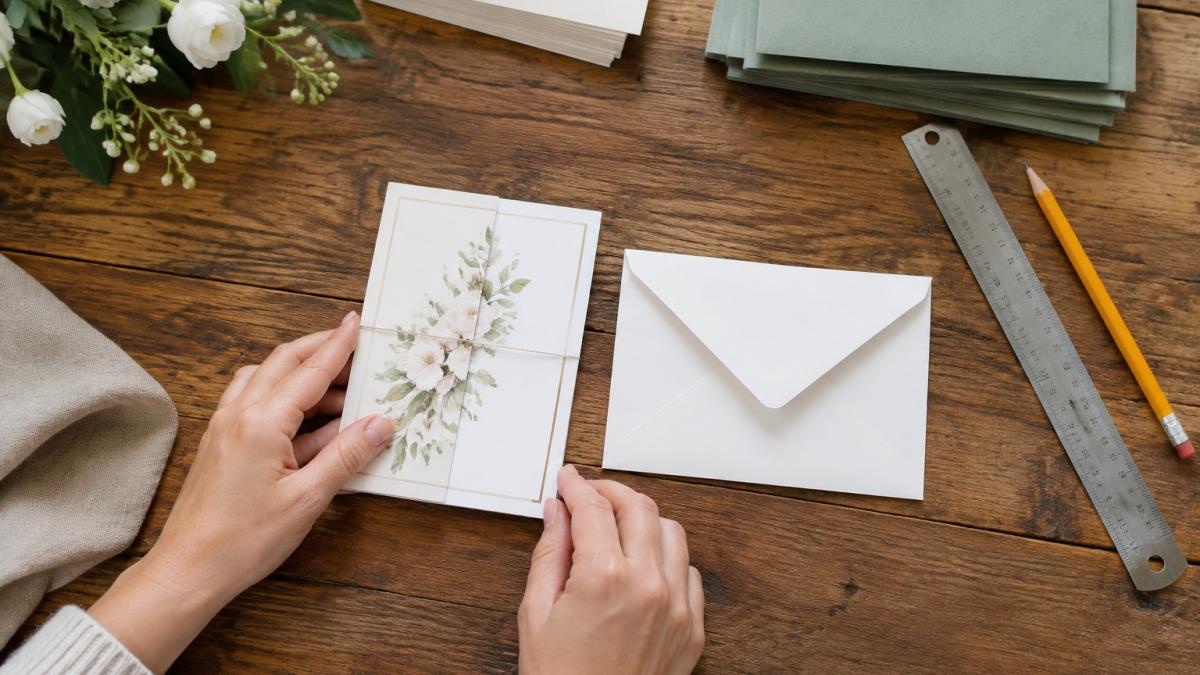
Step 1: Measure the finished, assembled piece
Measure the item exactly as it will be mailed, folded, closed, and stacked, not the flat sheet before folding. A 5" x 7" flat sheet folded in half becomes a 5" x 3-1/2" card, and that folded dimension is what the envelope must hold. Record width and height to the nearest 1/16 inch (or 1 mm), because rounding up a full quarter inch on a small card can push you into the next envelope size unnecessarily.
Step 2: Measure the full stack, not the top card
If the suite includes an RSVP card, reception card, map, or details card, stack every piece together and measure the stack as one unit. Paper thickness compounds: ten sheets of 110 lb cover stock stacked together add measurable bulk even though each sheet is thin. The envelope must clear the tallest and widest point of the assembled stack, which is usually the main invitation plus the thickest insert.
Step 3: Add clearance on each dimension
A common working rule is roughly 1/8 inch (about 3 mm) of clearance per side, or about 1/4 inch total per dimension, for a single flat card. For a multi-piece stack, add clearance to the stack measurement rather than the card measurement. For embellished suites, a belly band, a wax seal, a ribbon, or a mounted card, add extra room proportional to the added bulk, because a seal or band creates a raised point that catches on the envelope edge.
Step 4: Test-fit with a physical sample before ordering
Slide a printed or dummy card into a sample envelope and check three things: the card enters without bending, it does not shift more than a small amount side to side, and the flap closes flat without bulging. A bulge at the flap is the clearest sign the stack is too thick for that envelope and you need to size up.
Watch out: A card that fits a sample envelope flat may not fit once it is printed on heavier stock or assembled with inserts, so test-fit the final assembled suite, not a blank sheet of the same nominal size.
Step 5: Check the envelope's usable interior, not just its listed size
The listed envelope size is the exterior dimension. The gummed flap, side seams, and any lining reduce the usable interior slightly, so a card that measures exactly the interior width can bind. When a card is within 1/8 inch of the envelope's listed dimension, treat it as a tight fit and confirm with a physical sample.
!A pair of hands laying a folded wedding invitation card beside a blank envelope on a wooden table, with a ruler and pencil nearby
A quick fit-check table
| Assembled suite | Typical envelope | What to verify |
|---|---|---|
| Single 5" x 7" flat card | A7 (5-1/4" x 7-1/4") | 1/4" total clearance; flap closes flat |
| 5" x 7" card plus 2-3 flat inserts | A7, or A9 if the stack is thick | Stack height clears the flap; no bulge |
| Folded 5" x 7" sheet (5" x 3-1/2" folded) | A2 or A6 depending on fold | Folded dimension, not flat sheet |
| Card with wax seal or belly band | Size up one step from the flat-card pairing | Raised point does not catch or bulge |
If your measured suite does not match a standard pairing, choose the next envelope size up rather than forcing a tight fit. A slightly generous envelope reads as deliberate; a binding one reads as a mistake.
Choosing Your Envelopes and Ordering the Right Quantity
Ordering the right envelope is two decisions: which size holds the assembled suite, and how many to order so you are not caught short. Most guides cover the first and skip the second, which is where couples and planners actually get stuck.
Match the outer envelope to the largest item in the stack
Map every piece of the suite first: main invitation, RSVP card, reception card, details card, and any map or accommodation insert. Choose an envelope for each piece, then match the outer envelope to the largest and thickest item in the assembled stack, not to the main card alone.
A common pattern is to use the A7 for a 5" x 7" main invitation, the A6 for RSVP and reception cards, and the A2 for small enclosure cards.
Size up when the suite is layered or embellished
Belly bands, wax seals, ribbons, vellum wraps, and mounted cards all add bulk at a single point. Size up one step from the flat-card pairing when any of these are present, and test-fit the finished, embellished suite rather than a plain card. A raised seal or band that catches on the envelope edge will slow assembly and can crease the card.
Plan quantity with tolerances, not a round number
Order beyond your guest count to absorb the things that always happen:
- Addressing and printing mistakes. Misprinted or misaddressed envelopes cannot be reused, and a small buffer prevents a rush reorder.
- Assembly variation. Hand-assembled suites sometimes damage an envelope during stuffing, especially with tight fits or embellishments.
- Keepsakes and records. Couples often keep one complete suite for themselves, and planners keep a sample for their files.
- Late guest-list changes. A handful of extra envelopes covers last-minute additions without a second order.
A practical approach is to order a buffer proportional to your guest count rather than a fixed small number, and to order the buffer in the same size and stock so it matches the rest of the run.
Check mailing implications before you commit
Envelope size and suite bulk affect how the piece mails. Before ordering a full run, take one fully assembled sample to the post office and confirm how it will be handled.
Order the whole suite together
Order main envelopes, RSVP envelopes, and enclosure envelopes in the same order so sizes, stock, and finish match across the suite. Our A-6 announcement envelope suits RSVP and reception cards, while the A-2 announcement envelope works well for small enclosure cards, and the A-7 announcement envelope covers the standard 5" x 7" main invitation.


For design ideas that help your envelopes stand out, see our 10 Creative Envelope Design Tips for Event Planners. Atlantic Envelope has supplied printed envelopes to businesses and individuals since 1982, and our team is available to help you choose the right size and quantity.
Frequently Asked Questions
What size envelope should I use for my wedding invitations?
For a standard 5x7 inch invitation card, the A7 envelope at 5-1/4 x 7-1/4 inches is the most common choice. If your suite includes a folded card or extra inserts, measure the folded bundle rather than the flat card before you choose a size.
Should wedding invites be 4x6 or 5x7?
The choice depends on how much text and design you want to fit. A 4x6 invitation pairs with the A6 envelope at 4-3/4 x 6-1/2 inches and suits smaller guest lists or simple wording. A 5x7 card gives more room for names, dates and details, and pairs with the A7 envelope. Pick the size that fits your wording comfortably, then match the envelope to it.
How do I measure a wedding invitation for an envelope?
Measure the card's height and width with a ruler, and add the thickness of any inserts that will sit inside the envelope. Leave a small margin, roughly a quarter inch of clearance on each side, so the card slides in without bending. Test-fit one complete set with a sample envelope before you order the full quantity.
Do I need to account for RSVP cards when choosing an envelope?
Yes. An RSVP card and response envelope add thickness and sometimes width to the outer envelope. Stack all the inserts together, measure the bundle, and confirm it slides in without strain. If the suite is layered or embellished, consider a slightly larger envelope than the card alone would suggest.
