

Last Updated: October 23, 2026
Quick Summary
Digital communication wins on cost and speed, while envelope branding wins on attention and recall. Reserve physical mail for segments where one conversion justifies the higher cost per piece, and use email for volume work like reminders and follow-ups.
- Print the return address and recipient block in the same position on every mailing so recipients recognise the layout.
- Build the envelope order into the campaign timeline first, since print and delivery lead times do not compress.
- Give each mailing its own landing page, promo code or dedicated reply envelope to make responses traceable.
- Set an attribution window of two to four weeks for mail and state it in reporting.
- Use 10 Window Envelopes for monthly billing and 9 Regular Envelopes as return envelopes inside a 10.
Table of Contents
- Envelope Branding vs Digital Communication: The Core Trade-Offs
- Direct Mail vs Email Marketing: Where Each Wins
- Why Branded Business Envelopes Still Earn Their Place
- Business Envelope Design Choices That Affect Response
- Keeping Consistent Branding Across Print and Digital
- Measuring Results: Omnichannel Attribution and Accessibility
- Choosing the Right Envelopes for Your Mailing Mix
- Frequently Asked Questions
Envelope Branding vs Digital Communication: The Core Trade-Offs
Professional envelope branding vs digital communication is not a contest where one side wins outright. It is a question of which channel earns attention at which moment.
Here is the trade-off in one sentence: digital communication wins on cost and speed, while envelope branding wins on attention and recall.
Below, we break down the real trade-offs, the design choices that change response, and how to measure a mixed mailing programme in a way that survives a budget review.
Direct Mail vs Email Marketing: Where Each Wins
Direct mail vs email marketing comes down to a simple split: email wins the volume game, and physical mail wins the interruption game. Neither channel is better in the abstract. Each is better at a specific job, and the job is decided by the value of the response you are trying to earn.
Open Rates and Attention
An email competes with dozens of other messages in a crowded inbox. A branded business envelope sits in a small stack on a desk, and someone has to physically pick it up.
The mechanism behind that advantage is sensory. Paper has weight, texture and a printed surface that the hand registers before the eye reads the address.
The catch is that attention is not the same as action. A well-designed envelope gets opened; it does not guarantee a response. Treat the envelope as the first step in a sequence, not the whole campaign.
Cost per Lead and Response Time
Email wins on cost per lead almost every time. There is no paper, no print run, no postage, and a send takes minutes.
Response time flips the other way. Email responses cluster in the first hours after a send.
The practical question is not which channel is cheaper per piece but which is cheaper per qualified lead.
| Factor | Email Marketing | Envelope Branding / Direct Mail |
|---|---|---|
| Cost per piece | Low | Higher (paper, print, postage) |
| Speed to audience | Minutes | Days |
| Attention per message | Low, competes in inbox | High, physical handling |
| Response window | Hours | Weeks |
| Best for | Volume, reminders, follow-up | High-value offers, formal notices |
| Attribution difficulty | Moderate | Higher, needs tracking design |
A simple decision rule that survives a budget review: if the expected value of one conversion is small, email is the default.
Why Branded Business Envelopes Still Earn Their Place
Branded business envelopes earn their place because they carry brand identity into a channel with almost no competition. A plain white envelope says nothing. A printed envelope with a consistent logo, colour and typography says the sender is organised, established and worth opening.
Consider what the recipient sees before they open anything: the paper weight, the print quality, the return address block. Cheap, flimsy envelopes read as an unprofessional business, and recipients notice.
There is also a retention angle. Customer appreciation mailings, renewal notices and account statements arrive with more weight than an automated email. They feel deliberate.
Business Envelope Design Choices That Affect Response
Business envelope design choices affect response more than most senders expect. Paper stock, closure type and print method each change how the envelope feels in the hand and how it survives the postal system.
Paper, Closure, and Print Methods
Start with the practical constraints, then design around them.
- Paper stock: Heavier stock feels more substantial and resists tearing in automated sorting. Lighter stock costs less but creases and can look cheap.
- Closure: A gummed flap is the standard for business correspondence and holds reliably through postal handling. It is the right default for invoices and statements.
- Print method: Digital printing suits short runs and variable data. Foil stamping and embossing add a tactile, premium feel for announcements and event invitations, at a higher cost per piece.
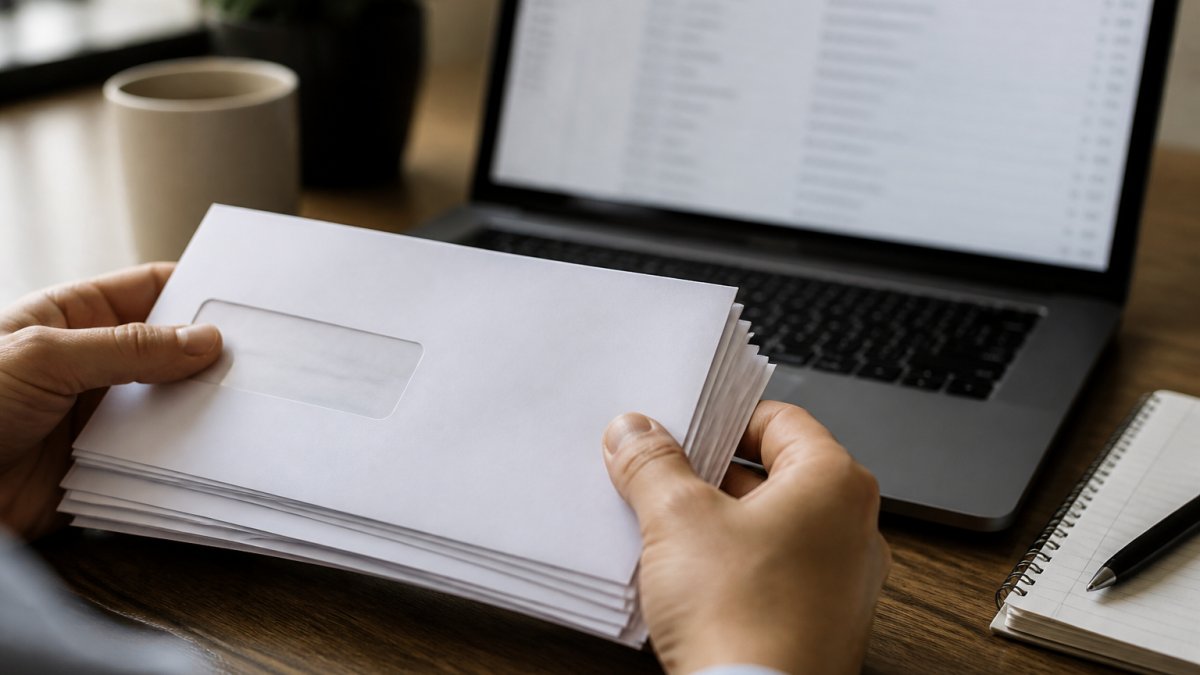
- Window vs plain: A window envelope displays the address printed on the document, which removes a labelling step and speeds up high-volume billing.
For high-volume billing, the #10 Window Envelope is the practical choice because the address comes straight off the statement. For letters and general correspondence, the #10 Regular Envelope is the standard format. For event invitations and marketing packages that should arrive flat, a booklet envelope keeps materials uncreased.

Keeping Consistent Branding Across Print and Digital
Consistent branding across print and digital is mostly a discipline problem, not a design problem.
Print and screen render colour differently, so specify your brand colours as print values and screen values separately rather than converting one from the other. Keep the logo lockup identical in proportion everywhere.
A simple brand sheet solves most of this. Record the logo files, the colour values, the approved typefaces and the envelope layouts in one document, then hand it to whoever places each order.
Measuring Results: Omnichannel Attribution and Accessibility
Omnichannel attribution is where most mixed mailing programmes fall apart. A recipient who receives an envelope, visits the site and converts a week later rarely gets credited to the mailing. Without a tracking design, physical mail looks worse than it is, and the channel gets cut at the next budget review even when it was working.
The fix is to design the measurement before the send, not after. Treat physical mail as one touch in a sequence and give it its own measurable routes back to you.
Building an Attribution Model for Physical Mail
Start with the routes a recipient can take, and make each one traceable:
- Unique response routes: Give each mailing its own landing page, promo code or dedicated reply envelope. A #9 Regular Envelope tucked inside a #10 package turns a passive reader into a measurable responder, because the reply comes back through a channel you control.
- Matched cohorts: Split your list so a control group receives no mail, then compare conversion over the full response window, not just the first week. The control group is what separates the effect of the mailing from the effect of the season, the offer or the email that went out the same month.
- Time-window attribution: Set an agreed attribution window for mail, commonly two to four weeks, matching the response curve, and state it in reporting so nobody compares a two-day email window with a two-week mail window.
- Self-reported source: Add a single "How did you hear about us?" field at checkout or on the reply card. It is imperfect, but it catches the offline touches that no tracking pixel will ever see.
Report the combined result, not the channel silos. A monthly view that shows email, mail and web together, with the control-group lift called out separately, is what keeps a mixed programme funded. When a mailing's incremental lift is visible next to the email numbers, the conversation shifts from "is mail worth it?" to "which segments should get more of it?"

Accessibility and Inclusivity in Design
Accessibility and inclusivity belong in the same conversation, because a campaign that excludes part of its audience is not measuring its real response rate.
On the physical side, envelope design should use high-contrast print, a legible return-address size and clear typography. Avoid low-contrast colour combinations and type so small that older recipients cannot read the sender.
On the digital side, the counterparts need alt text on images, readable font sizes, colour combinations that pass contrast checks, and landing pages that work with screen readers and keyboard navigation.
Choosing the Right Envelopes for Your Mailing Mix
Choosing envelopes for a mailing mix starts with the document, not the design. Match the envelope to what goes inside, then choose print and finish.
| Envelope | Size | Best For | Closure |
|---|---|---|---|
| #10 Regular Envelope | 4-1/8" x 9-1/2" | Business letters, invoices, statements, direct mail | Gummed flap |
| #10 Window Envelope | 4-1/8" x 9-1/2" | High-volume billing, payroll, financial correspondence | Gummed flap |
| 6 x 9 Booklet Envelope | 6" x 9" | Brochures, proposals, newsletters sent flat | Gummed flap |
| 9 x 12 Booklet Envelope | 9" x 12" | Catalogs, reports, unfolded 8-1/2" x 11" documents | Gummed flap |
| #9 Regular Envelope | 3-7/8" x 8-7/8" | Reply mail, remittances, return envelopes inside a #10 | Gummed flap |
We supply all five formats in multiple pack sizes, so a home-based professional can order a small quantity while a billing department orders in bulk from the same catalogue.

The challenge is not choosing between print and digital. It is building one programme where each channel does the job it is actually good at, and then measuring the combined result honestly.
Frequently Asked Questions
Is direct mail more effective than digital communication?
Neither format wins outright. Direct mail earns attention because it is physical and tactile: a branded envelope sits on a desk until it is opened, while an email competes with dozens of others in an inbox. Email wins on speed and cost per send. The stronger pattern is combining them: send a printed piece, then follow with an email reminder. Track response from each channel separately so you can see which one actually moves your audience to act.
What are the benefits of using branded business envelopes?
A branded business envelope signals legitimacy before the letter is opened. When the logo, return address, and typography match your other marketing collateral, recipients recognize the sender instantly and are less likely to discard the piece as junk. Branded envelopes also reinforce brand recognition across every invoice, statement, and direct mail campaign you send, turning routine correspondence into repeated exposure. For small businesses especially, a clean printed envelope makes a home-based operation look established.
How can businesses combine direct mail and digital marketing?
Use each channel for what it does best. Print carries the tactile experience and the formal weight; digital carries speed and tracking. Practical combinations include a printed announcement followed by an email reminder, a QR code or short URL on the envelope that leads to a landing page, and personalized direct mail triggered by online behavior. Measure the combined result with a simple attribution model rather than crediting only the last touch.
What should a professional business envelope include?
At minimum: your logo, full return address, and a clean, legible typeface that matches your brand identity. For window envelopes, confirm the address block on your document lines up with the clear poly window so no label is needed. Choose a size that fits the contents flat or folded as intended, such as a #10 for folded letters or a 6 x 9 booklet for unfolded brochures. Keep the design uncluttered so the address remains the most visible element.
How can a company keep its print and digital branding consistent?
Start with one brand sheet that lists exact colors, fonts, logo spacing, and tone of voice, then apply it to both your website and your printed stationery. Print colors behave differently from screen colors, so request a proof before a large run. Match the envelope's typography and logo placement to your email templates and invoices. Consistency across print and digital builds recognition, so a recipient who sees your email and later your envelope connects both to the same company.
