

Last Updated: November 7, 2026
Quick Summary
An expanded envelope is a flat mailing envelope built with a gusset or bellows fold along its long edges, so the body opens out to hold a thick stack of paper rather than a single folded sheet. The capacity is fixed at the point of purchase, which separates it from an expandable envelope whose gusset unfolds as you fill it.
- Measure stack thickness at the spine, not the loose edge, before choosing a gusset depth.
- Expansion depth of 5-15mm typically holds 50-150 sheets of 80gsm paper.
- Confirm internal dimensions rather than nominal sizes, since some suppliers quote external measurements.
- Seal the full length of the flap and keep heavy contents centred to avoid seam failures.
- For volume work, manufactured expanded envelopes give a consistent gusset depth across the run.
Table of Contents
- What an Expanded Envelope Actually Is (and Isn't)
- Expanded Envelope Sizes and Expansion Capacity
- Materials: Kraft Paper, Tyvek Envelope Options and Durability
- Closures, Opening Styles and Construction Details
- Matching Contents to the Right Envelope Style
- Shipping Bulky Documents Without Tears or Damage
- Making Your Own Expanded Envelope: A Short DIY Tutorial
- Choosing Your Expanded Envelope Order
- Frequently Asked Questions
What an Expanded Envelope Actually Is (and Isn't)
An expanded envelope is a flat mailing envelope built with a gusset or bellows fold along its long edges, so the body opens out to hold a thick stack of paper rather than a single folded sheet.
Here's the difference that decides your order. A standard business envelope holds a folded sheet and nothing more.
The distinction matters because the wrong call costs you a reprint. Below, we break down the four terms offices mix up, then work through sizes, materials, closures, contents and a short DIY option.
Expanded vs. Expandable vs. Expansion vs. Folded-Sheet
Four terms get used interchangeably in catalogues. They shouldn't be.
- Expanded envelope: a finished envelope manufactured with depth built in. The capacity is fixed at the point of purchase.
- Expandable envelope: an envelope whose gusset unfolds as you fill it, so capacity grows with the contents.
- Expansion envelope: an informal trade term for either of the above. Treat it as a description, not a specification.
- Folded-sheet envelope: a flat envelope sized for a folded sheet of paper. No gusset, no depth, no bulky contents.
For a fuller comparison of how booklet styles sit alongside these, our guide to what a booklet envelope is and when to use one covers the overlap.
Expanded Envelope Sizes and Expansion Capacity
Size and depth are two separate decisions, and most buyers only think about one. The long dimension sets what fits flat; the expansion depth sets how much fits inside. Use the guide below to work out both before you order.
Measure your contents first. Stack the documents, press them flat, and measure the thickness at the spine rather than the loose edge. A stack that measures 10mm loose will often compress to 6mm under a flap, and that difference decides whether you need a shallow or deep gusset.
How expansion depth maps to contents
Expansion depth is usually described in millimetres or in fractions of an inch. The table below groups the common ranges by what they realistically hold. Treat the sheet counts as planning estimates for standard 80gsm office paper, not guarantees, because paper weight and folding change the result.
| Expansion depth | Typical contents | Approximate sheet capacity (80gsm) |
|---|---|---|
| Up to 5mm | A few dozen unfolded sheets, thin brochures | 25-50 sheets |
| 5-15mm | Document stacks, contracts, thin catalogues | 50-150 sheets |
| 15-30mm | Bound reports, catalogues, mixed mailings | 150-300 sheets |
| 30mm and above | Bulky items, segmented accordion pouches, samples | 300+ sheets or non-paper items |
Matching envelope format to document size
Format names vary between suppliers, so check the actual dimensions rather than the label. The common patterns are:
- Document envelopes: sized for unfolded A4 or US Letter sheets, with modest depth for a few dozen pages. Look for internal dimensions slightly larger than the sheet so the paper doesn't catch on the seam.
- Booklet and catalogue styles: wider gusset for bound material and thicker paper stock, with a long-edge opening so the spine slides out cleanly.
- Accordion pouch formats: deep bellows divided into segments, useful when several items need to stay apart in one mailing.
- Small-format expanded envelopes: short-depth versions for cards, receipts and small parts that still need more room than a flat.
A common pattern is to size the envelope to the largest single item and then add depth for the rest of the stack.
Watch out: assuming a nominal size like 9x12 refers to internal dimensions. Some suppliers quote external dimensions, and a 9x12 external envelope may not take a 9x12 sheet flat. Confirm internal dimensions before a print run.
If you're weighing formats across a range, our guide to what a booklet envelope is and when to use one explains how booklet styles sit alongside expanded document envelopes.
Approximate sheet capacity by expansion depth (80gsm paper)
Materials: Kraft Paper, Tyvek Envelope Options and Durability
Paper choice decides whether your expanded envelope survives the postal system, and the trade-offs run in more than one direction. Brown kraft is the workhorse: recyclable in most municipal streams, stiff enough to hold shape, and available in assorted colours for organisation systems. A Tyvek envelope guide explains the alternative: a spun-bonded material that resists tearing and water far better than paper, at a higher cost and with different recycling routes.
The table below sets the common options side by side so you can match construction to the load rather than to the shelf label.
| Material | Tear resistance | Water resistance | Recyclability | Reuse potential | Best for |
|---|---|---|---|---|---|
| Standard kraft paper | Moderate | Low | Widely recyclable | Limited once sealed | Office correspondence, invoices, internal routing |
| Reinforced kraft (fibre-reinforced or laminated) | High | Moderate | Depends on the reinforcement layer | Limited | Heavy document stacks, catalogues |
| Tyvek (spun-bonded olefin) | Very high | High | Accepted at some specialist drop-off points, not typical kerbside | High if unsealed or lightly used | Heavy, irreplaceable or weather-exposed contents |
| Poly-based expanded mailers | High | High | Limited in many kerbside schemes | Moderate | Samples and items needing moisture protection |
Reading the trade-offs
Kraft paper handles office correspondence, invoices and internal routing without complaint, and it presents well for branded mailings because it takes print cleanly.
In practice, the failure point is rarely the paper face. It's the seam and the closure.
Watch out: assuming a heavier material automatically means better protection. A stiff reinforced envelope that is overfilled still splits at the gusset, and a lightweight kraft envelope that is correctly sized and sealed often arrives in better condition than an overloaded premium one.
For a full size, strength and printing comparison, our Tyvek envelope guide sets the two materials side by side.
Closures, Opening Styles and Construction Details
Closure and opening style determine how the envelope behaves in a mailroom, not just how it looks. Three closure types dominate:
- Gummed flap: moistened and pressed. Secure and cheap, but slow in volume.
- Self-seal adhesive strip: peel-and-close. The default for bulk mailing because it seals consistently.
- Hook-and-loop or garter closure: reusable, which suits internal routing rather than outbound mail.
Opening style matters just as much. A booklet opening runs along the long edge, so the envelope presents like a book and the contents slide out without catching. Pick the opening that matches how the recipient will handle it.
For offices running regular bulk mailings, our guide to secure adhesive seals for home office and bulk mailing covers which seal holds under volume.
Matching Contents to the Right Envelope Style
Match the envelope to the contents, not to the shelf label. That single rule prevents most returns.
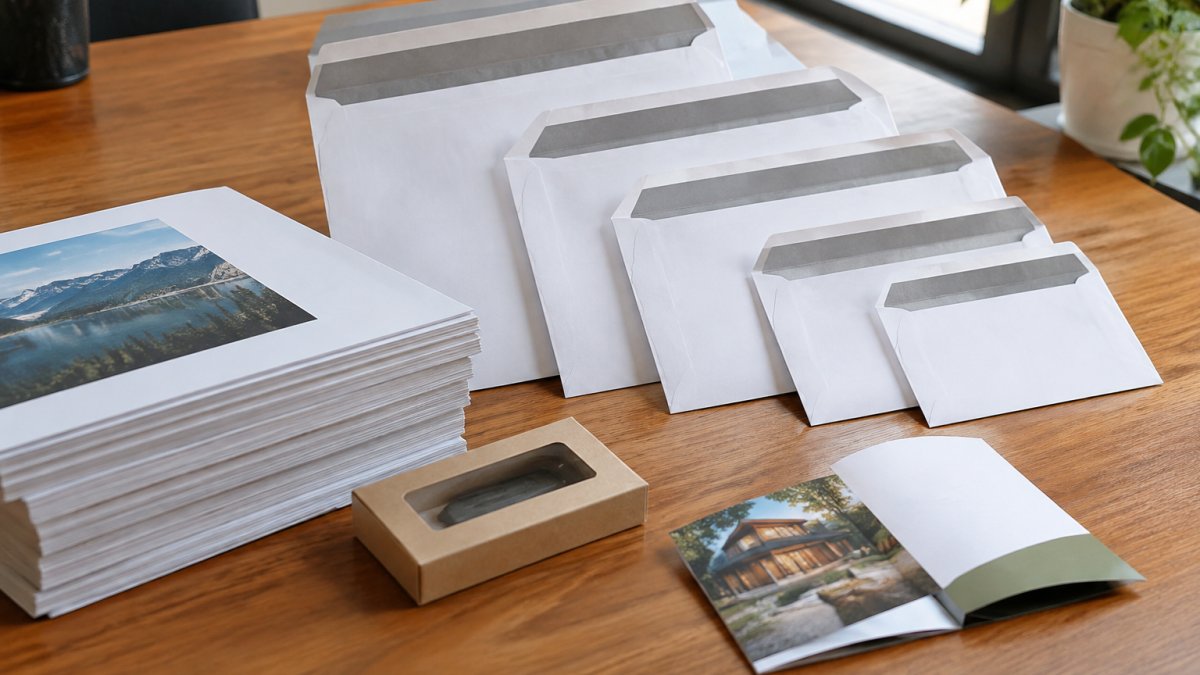
Work through the contents first. Unbound documents need a document envelope with enough depth to stop the stack shifting. Bound catalogues and reports need a booklet opening so the spine doesn't catch.
| Contents | Envelope style | What decides the fit |
|---|---|---|
| Invoices, statements, single sheets | Standard business or window | Fold size and window position |
| Thick document stacks | Expanded document envelope | Stack thickness at the spine |
| Catalogues, reports, bound material | Booklet envelope, long-edge opening | Trim size plus binding depth |
| Mixed items, samples, segmented mailings | Accordion pouch | Number of segments and depth |
| Bulky items needing protection | Tyvek expanded envelope | Weight and handling risk |
If your mailing is catalogue or report shaped, you can shop 6x9 and 9x12 booklet envelopes in plain or custom printed bulk packs.
Shipping Bulky Documents Without Tears or Damage
Bulky mailings fail at three points: the seam, the corner and the closure. Address all three before the first envelope goes out.
Reinforce the expectation internally first. A stack that fills an envelope to the point of bulging puts continuous pressure on the seams, and postal handling adds more. Leave a small margin of depth rather than packing to capacity.
- Seal the full length of the flap, not just the centre.
- Keep heavy contents centred so weight doesn't sit against one corner.
- Confirm your mail class accepts the thickness and rigidity before printing a run.
Making Your Own Expanded Envelope: A Short DIY Tutorial
A DIY expanded envelope is worth knowing for one-off mailings and upcycling, though it won't match a manufactured gusset for volume work. You need paper heavier than standard copy stock, glue, scissors and a ruler.
- Measure your contents as a flat stack and note the length, width and thickness.
- Cut your paper to twice the width of the contents plus the thickness, and the length plus two flaps.
- Score fold lines along both long edges at the thickness measurement to form the gusset.
- Fold the gusset inward, crease firmly, and glue the side seams.
- Fold the top and bottom flaps, then seal with glue once the contents are inside.
The common mistake is scoring too shallow. A gusset that's too narrow forces the paper to bow, and the seams pull apart in transit. Score generously, then test with the actual contents before sealing.
For anything beyond a handful of envelopes, the time cost outweighs the saving. Manufactured expanded envelopes give you a consistent gusset depth across the whole run.
Choosing Your Expanded Envelope Order
Getting the order right comes down to four numbers and one material decision: contents length, contents width, stack thickness, and quantity, plus kraft or Tyvek. Write them down before you open a catalogue.
Then check the details that cause reprints. Confirm the opening orientation matches how recipients will handle the envelope. Confirm the closure type suits your sealing process, whether that's a mailroom machine or a single desk.
At Atlantic Envelope, we've supplied printed envelopes to offices, event planners and home-based professionals since 1982 as a family-owned operation. If you're weighing options across the range, you can browse the full product catalogue and compare styles before ordering.
The difference between a mailing that arrives looking intentional and one that arrives dog-eared usually comes down to envelope selection, not luck.
Frequently Asked Questions
What is an expanded envelope?
An expanded envelope has a gusset or accordion fold along its sides that lets it swell to hold thick stacks of paper, product samples or other bulky items. A standard envelope stays flat, so anything thicker than a few sheets bulges or splits the seams. The expansion depth on a typical expanded envelope runs from roughly 2 cm up to 5 cm or more, which is enough for a 100-page report or a small catalogue. Look for the gusset on the long dimension when you are checking a product listing.
How do I determine the correct size for an expanded envelope?
Measure your contents at their widest point, including any folder or binding, then add a centimetre or two of clearance on each side. Check three figures: the long dimension, the open side and the expansion depth. If you are mailing a stack of documents, compress it slightly and measure the compressed thickness, because paper settles once it is inside. Ordering a size up is safer than ordering exact, since an overfilled expanded envelope puts strain on the flap and the seams.
Are expanded envelopes suitable for international shipping?
They can be, but the material and closure matter more on international routes because parcels pass through more handling. A tyvek envelope resists tearing and water far better than kraft paper, which makes it the safer pick for cross-border mail. Confirm the closure holds under pressure and that your contents are not so rigid that the envelope cannot flex. Check the destination country's customs and mailing rules before you send, and keep a small margin of expansion depth rather than filling the envelope to its limit.
What are the primary benefits of using an expanded envelope over a standard one?
The main benefit is capacity without a box. An expanded envelope holds thick stacks, bulky items and bound documents while staying lighter and cheaper to post than a rigid parcel. It also protects contents from bending, which matters for certificates, contracts and printed materials. For offices sending invoices, reports or event materials regularly, one expanded envelope replaces a box plus padding. The accordion pouch design also keeps papers from sliding out when the flap is open.
