

Last Updated: October 25, 2026
Quick Summary
A white envelope with window has a clear panel cut into the front so the recipient's address printed on the enclosed document shows through, removing the need for labels or hand-matched addresses. Choose the fold first, then the envelope: 10 takes a letter folded in thirds, booklet takes a half fold, and catalog takes flat sheets.
- The 10 envelope measures 4 1/8 x 9 1/2 inches and holds an 8-1/2 x 11 sheet folded in thirds.
- A typical address window is about 1-1/8 inches tall by 4-1/2 inches wide.
- Leave at least 1/8 inch of clearance on all four sides of the address inside the window.
- Self-seal closure is the practical choice for offices inserting more than a few dozen envelopes a day.
- Keep sensitive fields like account numbers and balances away from the window area.
Table of Contents
- White Envelope With Window: What the Window Actually Does
- Window Envelope Sizes: #10, Booklet and Catalog Formats
- Single Window Envelope: The Standard for Invoices and Statements
- Double Window Envelope: Return Address and Recipient in One Pass
- Window Envelope Address Placement and Alignment
- Window Film, Paper Weight and Privacy: What Buyers Overlook
- Printer Compatibility and Closure Choices for High-Volume Mail
- Ordering Window Envelopes From Atlantic Envelope
- Frequently Asked Questions
White Envelope With Window: What the Window Actually Does
A white envelope with window is a mailing envelope with a clear panel cut into the front, positioned so the recipient's address printed on the enclosed document shows through. If you want to step away from the standard look, see these alternatives to standard white business envelopes.
At Atlantic Envelope, we have supplied window envelopes to billing offices, event planners and home-based professionals since 1982. Below, we break down the formats, the measurements that matter and the trade-offs most buyers only discover after their first order.
The core advantage is speed: a folded invoice slides in and the address is already visible. The core risk is alignment, if the window and the fold don't agree, the address lands half behind paper.
Window Envelope Sizes: #10, Booklet and Catalog Formats
Three formats cover nearly all business mail; the choice comes down to how your document folds.
The #10 envelope measures 4 1/8 x 9 1/2 inches and takes an 8-1/2 x 11 sheet folded in thirds. It is the default for invoices, statements and checks, and it is the format most offices keep in stock.
Booklet envelopes open along the long edge and hold a sheet folded in half rather than thirds.
| Format | Typical Use | Fold Style | Best For |
|---|---|---|---|
| #10 | Invoices, statements, checks | Letter folded in thirds | High-volume billing |
| Booklet | Brochures, event programs | Sheet folded in half | Marketing and announcements |
| Catalog | Full-size documents | Flat or single fold | Contracts, portfolios |
What most guides miss is that fold style, not envelope size alone, decides whether your address lines up. Pick the fold first, then the envelope.
Single Window Envelope: The Standard for Invoices and Statements
A single window envelope carries one clear panel, usually on the left side, sized to reveal the recipient's address block. It is the workhorse of billing mail.
For a standard invoice run, the #10 window envelope does the job: 4-1/8 x 9-1/2 inches, a clear poly window on the left, a gummed flap, and compatibility with 8-1/2 x 11 sheets folded in thirds. Pair it with remittance envelopes for billing mail that includes a return payment stub. Print, fold, insert, the address is already showing.
The benefit shows up at volume: a team sending several hundred statements a month stops peeling labels and worrying about mismatched addresses. To standardize, view the #10 window envelope product page for pack sizes.

Watch out: a single-window design only works if your document layout puts the address in the exact spot the window expects.
Double Window Envelope: Return Address and Recipient in One Pass
A double window envelope has two clear panels: one for the recipient's address and one for your return address, both printed on the enclosed document.
You eliminate preprinted return addresses entirely, so one envelope style serves every mailing regardless of which office or department sends it.
The trade-off is layout discipline: two address blocks must land in precise positions, and your template has to be built around them. Change your letterhead margins and the return address slides out of view.
Window Envelope Address Placement and Alignment
Alignment is where most window envelope mailings fail, quietly, until a customer receives a statement with the address half hidden. The fix is a repeatable measurement routine built around three reference points: the window's top edge, its left edge, and the fold line of your document.
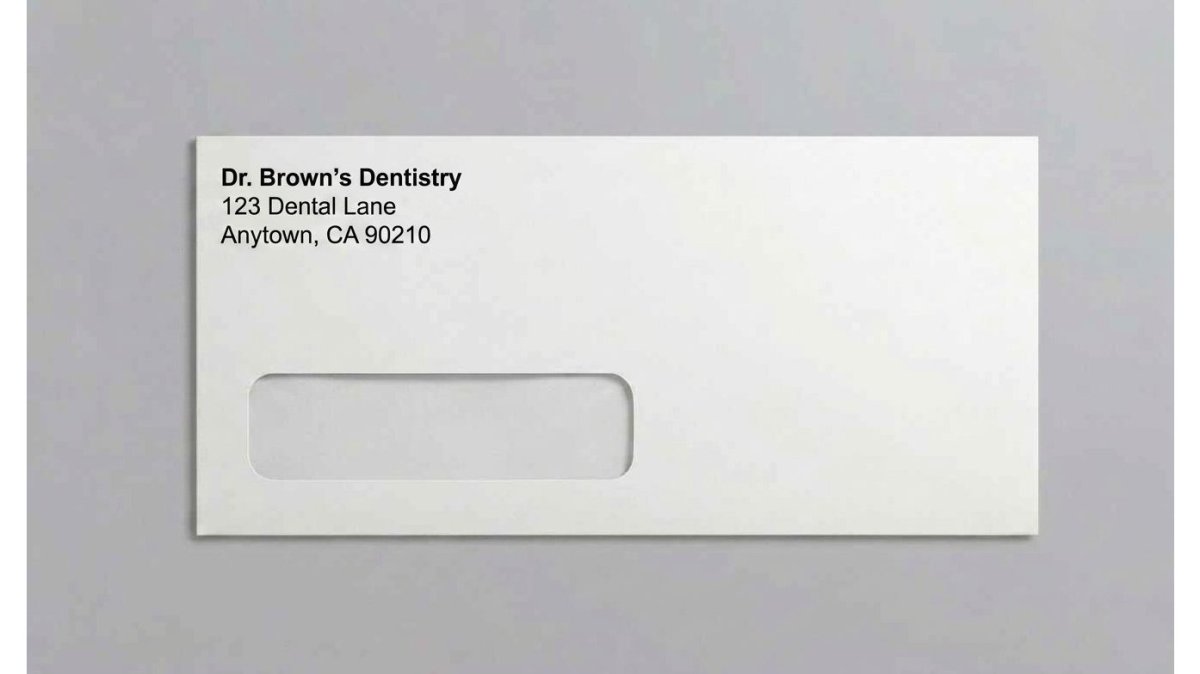
The three measurements that matter
Record all three of these distances for any format you standardize on:
- Top-of-window to top-of-envelope. On a standard #10 single-window envelope this is typically around 1/2 inch, but it varies by manufacturer. Measure your actual stock, not a spec sheet.
- Left-of-window to left-of-envelope. Left-window designs usually place the window roughly 7/8 to 1 inch from the left edge. Right-window designs mirror that distance from the right edge.
- Window height and width. A typical address window is about 1-1/8 inches tall by 4-1/2 inches wide, enough for a three- or four-line address block with a small margin.
Write those numbers down once and build your template around them, that single step prevents almost every misalignment complaint.
Mapping the address block to the fold
For a #10 envelope with a letter folded in thirds, the recipient's address must land in the top third of the sheet, the panel that faces the window when the letter is folded. A practical layout rule:
- Fold the sheet in thirds so the top third folds down first, then the bottom third folds up over it.
- The address block should sit roughly 1/2 inch below the top edge of that top panel and about 1 inch in from the left edge.
- Leave at least 1/8 inch of clearance on all four sides of the address inside the window. Anything tighter risks clipping after folding drift.
A common mistake is testing with a flat sheet instead of a folded one. Folds drift by a millimeter or two, often enough to clip the top line of an address. Fold first, then check.
Left versus right versus dual windows
Window position changes the layout math, not just the look:
- Left window is the standard for invoices and statements. The recipient address sits on the left of the document, and the return address is either preprinted on the envelope or placed in the top-left of the letterhead.
- Right window is used when the document's address block is right-aligned, common in some accounting templates and in mail where the return address is preprinted on the left of the envelope.
- Dual (double) window puts both the recipient and return addresses on the document, eliminating preprinted return addresses but doubling the layout discipline: two blocks must land in two precise positions, and any letterhead margin change can push the return address out of view.
A quick pre-print checklist
- Measure the window's top, left, height, and width on your actual envelope stock.
- Build the address block to those measurements with 1/8 inch clearance on all sides.
- Print one test sheet, fold it exactly as production will, and hold it against the envelope.
If you are unsure which window position matches your layout, our #10 window envelope product page shows the standard left-window configuration.
Window Film, Paper Weight and Privacy: What Buyers Overlook
Two envelopes of the same size can feel completely different in the hand, and the difference comes down to film, paper stock, and how well the design protects what is inside. Most product listings mention these attributes but never explain how they interact, which is where privacy problems start.
Window film versus open or cut-out windows
Window film is the clear panel itself. Poly film is the common choice: it stays clear, resists tearing, and feeds through most laser printers. An open or cut-out window leaves the document exposed with no film, avoiding glare and film-related printer risk but leaving contents vulnerable to scuffs, moisture, and casual prying in transit.
A practical comparison by printer type:
- Laser printers: Film must be formulated to tolerate fuser heat. Untested film can curl or wrinkle as it passes the fuser. Open windows eliminate that risk entirely but expose the document to toner smudging if the sheet shifts.
- Inkjet printers: Film is generally safe, but some films attract ink and smudge. Open windows avoid the issue but expose the print to handling.
- Hand assembly (no printing through the envelope): Film and open windows both work; choose based on privacy and appearance rather than printer behavior.
Paper weight and finish
Paper weight drives how the envelope feels and feeds through a printer. For more on weighing stock and finish, see our guide to choosing professional business envelopes. 24 lb paper is the standard for business envelopes and handles everyday correspondence well; heavier stock reads as more substantial, which matters for client-facing mail.
For privacy, weight matters less than opacity. A heavier sheet inside the envelope blocks more light, which reduces show-through even before you add a tint.
Security tint and document positioning
Security tint is a patterned lining printed inside the envelope. It obscures the contents from anyone holding the envelope up to a light, which matters for invoices, checks, and anything containing personal details. If your mail includes account numbers or payment amounts, a tinted lining is not optional.
Tint alone is not enough. Document positioning matters just as much:
- Keep sensitive fields, account numbers, balances, signatures, away from the window area. Anything visible through the window is visible to anyone handling the envelope.
- Fold so that the back of the sheet, not the printed front, faces the window wherever possible. The blank side reveals far less.
- For checks, position the check so the payee and amount do not sit behind the window; the remittance stub should be what shows.
Matching stock to the recipient
Match the stock to the recipient and the contents: a client statement deserves heavier paper and a tinted lining; an internal routing slip does not.
Printer Compatibility and Closure Choices for High-Volume Mail
Printer compatibility and closure type are the two specifications that decide whether a bulk mailing runs smoothly or jams halfway through.
Window envelopes generally feed well through laser printers, but the film and the flap are the risk points. Film not formulated for laser heat can curl or wrinkle as it passes the fuser.
Closure comes in two main types. Regular gum requires moistening, which is fine for low volumes and hand assembly. Self-seal uses a peel-and-press adhesive strip and is the practical choice for any office inserting more than a few dozen envelopes a day. Self-seal also produces a more consistent seal, which matters when envelopes travel through automated sorting equipment.
Watch out: adhesive that sits in storage for years can lose its grip.
Ordering Window Envelopes From Atlantic Envelope
Choosing the right white envelope with window comes down to four decisions: the fold your document needs, the window configuration that matches your address layout, the paper and film that suit your privacy requirements, and the closure that fits your volume.
We supply standard business and window envelopes alongside custom announcement sizes, in quantities from small office packs to bulk orders for large campaigns.
Most mail problems trace back to a mismatch between the document and the envelope, and that mismatch is easy to prevent with one test sheet and a careful measurement.
Frequently Asked Questions
What is a window envelope used for?
A window envelope shows the recipient address printed on the document inside, so you skip address labels and a second printing pass. Offices use them for invoices, statements, payroll checks and billing notices. The #10 white envelope with window suits 8-1/2 x 11 sheets folded in thirds, which covers most business mail. For mailings where the address must stay hidden, a security tint behind the window blocks it from view.
What is the difference between a single window envelope and a double window envelope?
A single window envelope has one opening, usually on the left, that shows the recipient address.
What size is a standard #10 window envelope?
A #10 business envelope measures 4-1/8 x 9-1/2 inches. The window sits on the left side, positioned to show an address printed on an 8-1/2 x 11 sheet folded in thirds. It is the most common format for invoices, statements and checks. Larger formats such as 9 x 12 booklet and catalog envelopes suit unfolded documents; confirm the window position before ordering in bulk.
How do you make sure the address lines up with an envelope window?
Set your document margins so the address block lands where the window will sit once the sheet is folded. Print one test sheet, fold it, and hold it against the envelope before running the full job. Check both the recipient block and, on a double window envelope, the return address. Keep the address clear of the fold line, and confirm your printer handles the paper weight you plan to use.
